
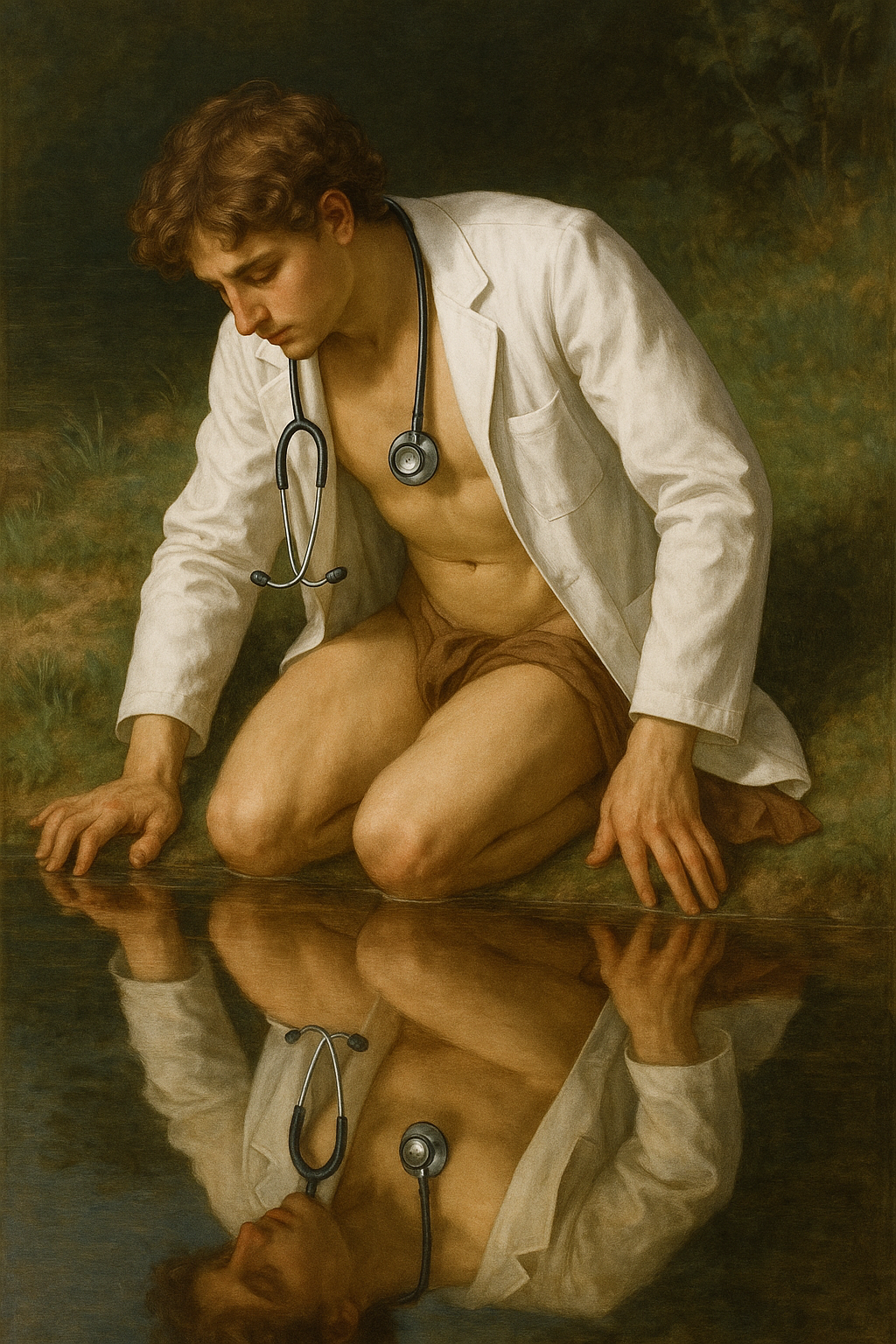
Many of Freud’s ideas linger with us to this day. A few are disastrously misapplied in some situations but still capable of offering insights in other situations. One of these Janus-Faced ideas was about transference reactions.
One day a woman in therapy threw her arms around Sigmund. Rather than reach for the obvious explanation, discombobulated he figured she was fantasizing about her father. What he had experienced, he decided was a transference reaction. It was a lightbulb moment, leading him to figure maybe all the women who had been telling him about sexual abuse in childhood were really telling him about their daddy fantasies. The abuse had never happened.
Industrial and Political systems worldwide have ever since used this thinking to argue that if you’ve been troubled by the horrors of war or some disaster this has nothing to do with the war or the disaster, it’s all about your failure to handle childhood developmental challenges. See The Great Silence.
Seventy years later, psychoanalytically oriented psychiatrists seeing patients recently started on the early tricyclic antidepressants described the effects of some of these medicines as altering their patients’ transference reactions.
Arvid Carlsson noted the analysts linked this effect to drugs that acted on serotonin systems. It didn’t happen with desipramine or nortriptyline which act on norepinephrine uptake but not serotonin uptake. This led Carlsson to create an SSRI to see what was going on. It became clear that an SSRI induced alteration of transference reactions means a reduction in emotional reactivity.
See this pre-SSRI description of the transference changes analysts were spotting The Antidepressed Personality

Clinical Change
While the SSRIs were incubating, medical practice was undergoing significant changes. There was a move quietly pushed by companies to rebrand Company Assays done to get licenses to market their products as Randomized Controlled Trials (RCTs) and to insist that these Assays offered Gold Standard Evidence as to what company medicines do – See Health’s Illusions and The Once and Future Pharmacopsychology.
If like a lot of people, you are confused by the word Assay, substitute Test for Assay. The problem with test is distinguishing acronyms – how do you tell RCTrials from RCTests.
To understand what is going on you need to realize company tests/assays are not RCTs. There are superficial similarities between RCAs and RCTs just as there are between love-making and rape but the intentions in the two cases are quite different. Juries, thankfully, go by intentions rather than superficialities. RCTs aim at informing clinical practice. RCAs aim at capturing clinical practice – at making sure doctors do not have a thought in their head not put there by a company.
Even in the case of RCTs, the professional medical view up to 1990 was that RCTs done by angels tell a doctor nothing about what a drug is doing or has the capacity to do to the patient in front of them. RCTs do not give us Gold Standard Evidence. All company tests/assay deliver is Hearsay not evidence.
The diverging views clashed head on in 1990 when Martin Teicher and colleagues reported that Prozac had the capacity to cause some people to become suicidal and commit suicide. Lilly claimed the licensing tests they had done for Prozac showed no evidence that it could cause suicide.
In the face of Eli Lilly’s refusal to budge, with GSK and Pfizer supporting them, FDA and other regulators capitulated. Reports like Teicher’s would have previously led to label changes but Lilly figured they could win any fight in court or in public by pushing their Evidence Based Medicine (company assays/tests) Trojan Horse. They were helped hugely by Richard Smith and BMJ endorsing them – Vampire Medicines. With BMJ support locked in place, very soon afterwards companies colonized the newly emerging Guideline business.
Guidelines helped create Trans-Medicine leading many doctors to transition from professionals into bureaucrats – people who follow orders from above rather than exercise their own judgement as Teicher and colleagues had done and as RxISK does and as anyone who takes an adverse effect to a doctor attempts to do.
One of the key concepts that came out of this clash between companies and regulators, which the regulators were forced to adopt was the notion of Treatment Hesitancy. Regulators and companies lined up against Treatment Hesitancy.
A decade later, helped by Andrew Wakefield handing regulators and companies a Gift Horse, Treatment Hesitancy incorporated Vaccine Hesitancy which has proven a powerful rallying call for bureaucrats (regulators) who want you to follow orders.
Combatting Treatment Hesitancy is joined at the hip to ideas about False Balance. If company Assays/Tests have not shown a problem exists it would be a False Balance to give air time on CBC or BBC, NEJM or BMJ to claims that any treatment can possibly cause any adverse events at all – see this 2011 BMJ article when Balance is Bias. Or see Silencing Doctors, Silencing Safety.

Delegated Narcissism
RCAs allow companies to create a Wonderland. The label attached to company drugs acts like the labels Alice faced in Wonderland where food and drink were labeled Eat Me and Drink Me leaving her incapable of not doing this. FDA labels have the same effect on sophisticated liberal elite women who won’t take soft cheeses, or processed meats but consume prescribed SSRIs in ever greater quantities when pregnant.
Decades ago, the psychoanalysts who spotted serotonergic alterations of transference reactions began telling us what was going on here. Companies have nudged doctors into Delegating their Narcissism to FDA – nudged doctors into hiding behind bureaucrats as father figures.
As children, we Delegate our Narcissism to parental figures. If living in dangerous times or vulnerable for other reasons, we may delegate it to dictators, or gurus. Delegating narcissism to bureaucrats suggests extreme vulnerability. Daddy issues again.
Managing treatment hesitancy for life-saving treatments is one thing but as Goldman Sachs have told us, making drugs that save lives is a bad business model – the pressure to push down the price of life-saving drugs is huge. Not only do companies no longer aim to produce life-saving drugs but almost none of the licensing tests for the drugs they do produce show lives saved or reduced disability burdens.
Companies run their tests for drugs in conditions where whatever the possibility of a real underlying disorder, the market lies in a cosmetic or identity disorder penumbra surrounding what may be a real condition.
From the 1950s to the 1990s doctors were supposed to be a bulwark against this consumerism, were supposed to restrict the giving of medicines to the treatment of real diseases – given the accepted wisdom that there was a very real chance these drugs could go badly wrong and needed handling with care. The job of physicians was to save lives and extend life expectancies. But with the emergence of Assay Based Medicine and its incorporation into Guidelines, along with the great and the good all lining up to tell doctors to follow the evidence and companies openly stating very few doctors have a thought in their heads not put there by them, doctors found themselves in the firing line.
Doctors are no longer dealing with a Big Pharma making life-saving drugs, but with Big Propaganda, who have realized the goal of propaganda – to become invisible. When journals like the BMJ publish the propaganda, it becomes difficult for doctors to manage and they haven’t worked out how to do it.
This puts enormous pressure on any doctors who want to be seen as professionals. Few of them are natural Vampire-Slayers.

The easiest thing to do is to succumb to the belief that following the evidence is the professional thing to do. So they roll over and diagnose ASD and ADHD and threaten to fire people from their list if they don’t start lipid-lowering drugs for minimally raised cholesterol or bisphosphonates for minimal bone thinning.
This sets up a problem as Erving Goffman noted as far back as 1961 in Asylums:
The farther one’s claims diverge from the facts, the more effort one must exert and the more help one must have to bolster one’s position
Having prescribed fools gold, to be then faced with patients who make a convincing case their treatment has caused serious problems is a serious challenge for a doctor not confident enough in their own judgement to go against the guidelines.
A doctor not able to say – look just as a Bad Trip on LSD is not a step on the road to a Good Trip, I agree that if you have become suicidal on your SSRI this is not about to suddenly morph into a good response, so we need to get you off this drug – bearing in mind that this might not be plain sailing either.
Not enough doctors are able to do this.
As a result, the public rarely get to see anything but spokes-people festooned with EBM and Follow the Science labels, and a chorus line of Narcissistic Disordered Doctors, swinging along to a Tom Lehrer like song called Let’s Do the Narcissistic Tango Again.
If their defenses are challenged, Narcissists get aggressive and pick on someone they figure is more vulnerable than they are. Our current system breeds this violence.
Clinical psychologists often seeing patients put on psychotropic drugs are mostly too scared to hint to a patient that their obvious side effects are treatment related as they risk getting a threatening email or worse from the patient’s doctor telling them they are not licensed to practice medicine.
Response like this are not just bad healthcare – they fly in the face of Science. Science is about getting people with different points of view into a room to come to a consensus on what is observable in front of them. See In Praise of SSRIs.
A journalist researching adverse events recently told me many of the doctors she interviewed figured patients who claimed to know that their drug had caused the adverse effects they thought it had caused, rather than being correct had what ‘these doctors’ called narcissistic personality disorders.
This is an inevitable consequence of Doctors Delegating their Narcissism to bureaucrats. Narcissists use aggression to manipulate others into taking the blame.
Over the Rainbow
We need to find a way to give this Scarecrow a Brain, along with Courage and a Heart. We also need to remove the White Coat and Stethoscope.
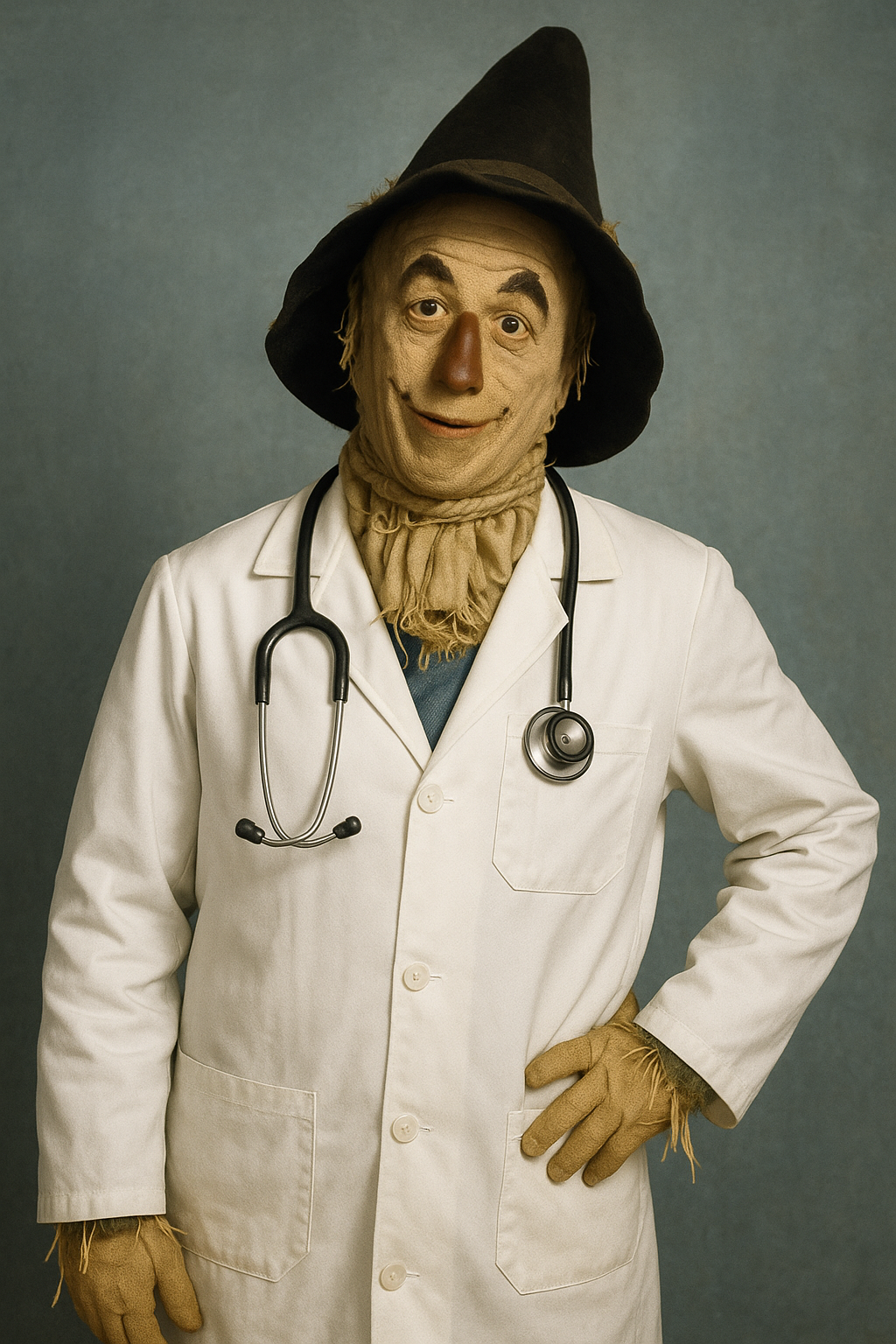
Ironically, given the role of Freudian thinking in pointing to the dynamics at play in what is going on, the end result is that not just mental health medicine, but increasingly the rest of medicine also, now resembles nothing so much as psychoanalysis.
Faced with skeptical patients, analysts viewed our resistance to analytic insight as the best evidence of our mental illnesses. Here was the point where psychoanalysis lost touch with science. Science seeks consensus on observables. Our opinions about how these observables come about can be wrong and open to challenge but it should be possible to get consensus on what is being observed. The person on treatment may have misguided opinions as to what is producing the observables but they have a privileged position on the observables and a denial of the existence of these observables is just plain wrong. .
Karl Kraus in 1939 famously described psychoanalysis as the mental illness it seeks to treat. Given that they have to make us diseased in order to give us meds, it is not surprising that psychiatrists and doctors more generally have come as close as the analysts once were to being the illness they seek to treat.
Given that the system of having some medicines prescription only was devised to manage addicts, it is not surprising that doctors like the clergy who once dealt with our original sin, can effortlessly make us feel small as well as ill-equipped to deal with them.
While surgeons have often been viewed as arrogant, surgery is not bedeviled by narcissism in the same way. Cosmetic surgery may be a growing problem, but it is still easy to separate it from mainstream surgery and dismiss claims that people should get disability payments for vaginas, breasts, noses or hairlines that aren’t as perfect as we would like.
Based on company propaganda that the magic lies in their pills rather than in the prescriber, perhaps the rapidly increasing replacement of doctors (not surgeons) by nurses and other cheaper prescribers will deal a blow to both medical pockets and narcissism.
Imagine what might happen if we got rid of prescription-only and doctors had to offer something beyond the access to medicines until recently we could only get from them. If we came out of a doctor’s office appreciating something we had learnt, along with the pleasure of validation, and an invitation to become a research assistant, think of how much better we might be able to make her or his job. Think of how much between us we might have learnt from the Gift that SSRIs should have been.
There is a fabulous scene in One Flew Over the Cuckoo’s Nest which captures everything – in the link here. Challenged, Randall McMurphy (Jack Nicholson) introduces the patients who’ve escaped with him from the Asylum, as Dr X, Dr Y etc – and you can see each of their faces light up as he does so – the restoration of a humanity.
If doctors don’t embrace this possibility, they may have no future except to become health service managers – who are in general just about as insufferable as it is possible to be.
This post links to
- I Come to Praise SSRIs not to Bury Them
- Interoception needs Intrepid Interoceptors
- The Once and Future Pharmacopsychology
There’s a comment on the post below that prompted this clarifying response
The challenge for any of us is to listen to people who bring things to us and attempt to come to a consensus on observables. The analysts got the observables right with serotonin reuptake inhibitors – there is a very very very obvious change in the person’s affect if you’re observing – it can be spotted as people enter the room before they open their mouth. What these later analysts got wrong was labelling it as a transference reaction – wrong in the sense that this opinion as to what is going on is misleading/wrong.
With delegated narcissism, again there is an observable – doctors. who should be all ears and supportive for a person who has just been put on meds that are significantly more likely to increase disability rather than reduce it, are instead nasty with their hands clapped over their ears in case they might hear something that discombobulates them. Delegating narcissism may be the wrong term to explain this observable and we need to remember this but it’s a very seductive term to use.
annie says
Delegating narcissism to bureaucrats suggests extreme vulnerability. Daddy issues again.
but almost none of the licensing tests for the drugs they do produce show lives saved or reduced disability burdens.
The farther one’s claims diverge from the facts, the more effort one must exert and the more help one must have to bolster one’s position
The father, one’s claims diverge from the facts
Daddy again
introduces the patients who’ve escaped with him from the Asylum, as Dr X, Dr Y etc – and you can see each of their faces light up as he does so – the restoration of a humanity.
Daddy again
psychiatrists and doctors more generally have come as close as the analysts once were to being the illness they seek to treat.
The old ace in the hole
Patrick Daniel Hahn says
The young Dr. Freud had it right back in 1895. He’d had patient after patient — most of them women, but some men as well — come into his office and reveal that they had been violated, sexually, always beginning before the age of eight, and he concluded (quite reasonably, IMHO), that these early childhood violations had something to do with their present-day difficulties.
But that same year, he did an abrupt about-face and decided that these reports of these early childhood violations were just “infantile fantasies.”
Let’s take a moment to consider how bizarre Dr. Freud’s position was at this point. He had been adamant that the conditions he treated (“hysteria,” “neurosis,” etc.) were actual diseases, no less than smallpox (his comparison). Now he was saying that these actual diseases were caused by events that never happened.
Dr. Freud walked up to the edge of the cliff, peered down — and then turned away. This was a truth the world was not ready to hear.
Dr. David Healy says
Patrick
There is more than one problem here. Freud discovered fantasy at this point and that too is a real discovery. What he didn’t find was a way to distinguish between real reports of hazards on meds or child abuse and fantasies.
We now know how easy it is to generate (recover) memories of abuse that never happened. Freud’s therapeutic approach up to 1895/6 was not just listening to people tell him about abuse, he was practicing hypnosis and probably in many cases suggesting to folk something about the dramas he wanted to hear which coming to light would cure everything – but didn’t.
The challenge for any of us is to listen to people who bring things to us and attempt to come to a consensus on observables. The analysts got the observables right with serotonin reuptake inhibitors – there is a very very very obvious change in the person’s affect if you’re observing – it can be spotted as people enter the room before they open their mouth. What these later analysts got wrong was labelling it as a transference reaction – wrong in the sense that this opinion as to how to explain the observable misleads as to the nature of the change.
With delegated narcissism, again there is an observable – doctors. who should be all ears and supportive for a person who has just been put on meds that are significantly more likely to increase disability rather than reduce it, are instead nasty with their hands clapped over their ears in case they might hear something that discombobulates them. Delegating narcissism may be the wrong terms to explain this observable and we need to remember this but it’s a very seductive term to use
D
Harriet Vogt says
A celebrated event when I was a student was the annual Freud debunking lecture. Delivered by the ‘coolest dude’ in the Psychology faculty – ‘cool’ by virtue of a laconic manner, a mass of blonde curls – and no competition for the accolade.
I can still visualise the lecture hall and feel the mood of anticipation. One key message delivered by Dr Gareth Cool was that a critical factor that seemed to be overlooked in all the theoretical complexity of Freud’s sexual theories – women in Catholic Vienna at that time were sexually frustrated owing to the supposedly forbidden practice of coitus interruptus.
This seemed to me to epitomise so much of what was wrong with psychiatry – and still is.. A narcissistic urge by the specialty to intellectualise human suffering for its own benefit and, in so doing, disconnect from the individual human beings it purports to serve.
I don’t care how much the smarter specimens protest that diagnostic categories – didn’t you say there are now 1000 of them? – are nothing more than useful constructs- they are too often treated as reified and notably by patients.
With this degree of alienation from suffering mortals- is it any wonder that these perfectly well intentioned doctors cannot see the effects that the drugs they prescribe are having on their patients. Even leaving aside that they have neither the wit nor the medical education it seems to understand the pharmacopsychology. You’d think it would be obvious to anyone listening to patients – on or dumping SSRIs – talk about dizziness, sexual problems, visual weirdness, bladder and bowel dysfunction, alcohol cravings etc. that these drugs are affecting far more than the brain.
A recent example. When a friend complained to her son’s psychiatrist that he was so zombified and disconnected from his mind and body by the max dose prescribed drug regimen that he never sensed the need to wash – she was told this was ‘a lifestyle choice or his condition’.
Although 1000 diagnostic categories is clearly a preposterous number – might as well make it 1001 – and add NDD.
Vic says
How so that educators, teachers, and on site psychologists – employees of the Departments of and for Education, are given free rein to diagnose and label children “in their care”, and send them for referral to psychiatrists for official reports? Teacher knows best, and any parent who does not agree, is then also labelled as difficult, problematic.
How so that society, you and I, allow these Narcissistic Professionals into our lives and our families lives and our children’s lives?
Abuse of powers. Moral panic -narratives. Every person for themselves. If people can be diminished, why not.
Propaganda!