
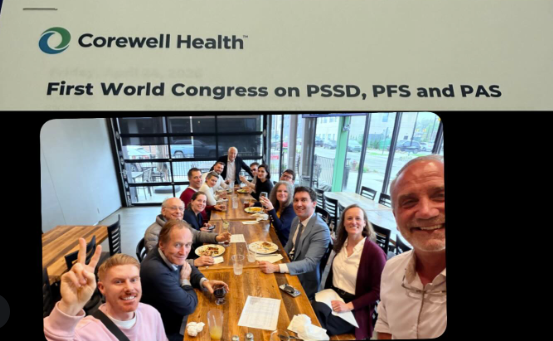
Over a few days in late April 2026, Ken Peters, a Professor of Urology in Detroit, chaired a meeting he had organized that pulled together some of the folk most engaged with a set of enduring medicine induced sexual dysfunctions – Post SSRI Sexual Dysfunction (PSSD), Post Finasteride Syndrome (PFS) and Post Accutane Syndrome (PAS). (Accutane is isotretinoin).
Ken figured it was time to put in place a position statement outlining the disorders, research leads, possible treatments and future prospects – with a view to raising funds among other things.
The photos make it clear this was a small group. This post picks out a fraction of the highlights from this small but extraordinary meeting.
The Engaged
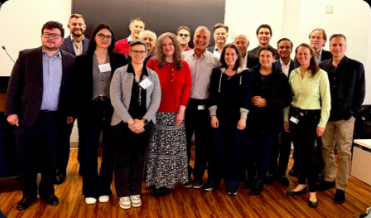
The folk most engaged in the profound issues these enduring syndromes throw up have been the injured who have skin in the game as a result and have been forced to become citizen scientists.
In the case of Finasteride, the injured have linked up with urologists, prescribers of Finasteride for established prostate problems, among which there are a small number, who like Ken have recognized and accepted that Finasteride can cause problems they never imagined it might cause.
The greatest number of those affected clearly have PSSD rather than PFS but they, despite high profile campaigns, have found it difficult to impossible to make linkages with mainstream psychiatry.
The group least represented and missing at this meeting were folk with isotretinoin linked problems. This is ironic in that if ever a group had skin in the game it is those who took isotretinoin – See Isotretinoin and Consent and also Finasteride and Consent.
I’ve mentioned citizen scientists and the injured. At this meeting, there was reference to patient advocates (PAs). For me one of the most important features of the meeting was how inadequate a label PA is for the contribution the injured have made in this domain and likely across all of medicine.
Mark Millich, Robb Dixon and Daniel Demers have been doing the science. Along with a host of others, like Roy Whaley, Rosie Tilli and others in the PSSD Network and other groups, they have been and are trying to get physicians and researchers to step up to the scientific plate. But they have found it very difficult to get so-called scientists, academics and physicians to engage with the science and with a set of issues which are of profound medical importance.
Why on earth am I warbling about Turning the (established) World Upside Down in this manner?
Science is about observables in the first instance. Hypotheses, test-tubes, brain scanners, statistics and experiments might come later. It begins with what you see, smell, or feel right in front of you – in medicine above all but not just in medicine.
Mark Millich brought this point home in a fabulous manner. I mention Mark perhaps because we’ve had no contact before and much of what he said was new to me. He made a compelling case that his body had changed dramatically on stopping Finasteride showing photos and videos to bring home the point. His huge loss of muscle mass, with weight changes etc. was noticeable to family and friends.
There could be very little argument about these observations. The eyes of any so-called clinician or scientist meeting Mark should light up with a ‘this-is-interesting’ and ‘needs-to-be- engaged-with’ glint. Not just because it might help Mark but because the observer might figure this is his/her route to fame and fortune. But instead the clinicians and researchers somehow manage not to see the changes in front of them – and science cannot be done without observables like these.
There can be a dispute about whether the changes in Mark can or should be described as feminization or de-masculinization and mention of these hypotheses, which might be wrong, might put people off – even though these words open a door to some profound aspects of the sexuality of all us. We all stand to learn a lot about ourselves, even if there is nothing at the moment wrong with us, from what people like Mark are going through, which force them to think scientifically or experimentally as a result.
The link between Finasteride and Mark’s observables (rather than theories about these observables) becomes unarguable when asked how long after stopping Finasteride did these and related changes start happening in him, Mark answered 10 days which maps perfectly onto Finasteride’s biological effects.
The effects of Finasteride on Mark were more neurological and musculoskeletal than sexual. So how does all this fit into a meeting about the effects of medicines on sexual function?
Beyond Genitals
Some time ago, a series of papers began coming out of Irwin Goldstein’s department in San Diego, which caused great alarm to people with PSSD. The work being reported, or at least as it was picked up by those at risk, indicated that the genital area in both men and women was badly affected – damaged – fibrosed. Many of the injured got the impression they had an irreversible and permanent condition. There was no hope. I spent a good deal of time telling alarmed people that this didn’t ring true to me – try not to take it too seriously.
Showing some dramatic images at the meeting – note images are observables – Irwin made an impossible to argue with case. Except, the images showed something quite different to the interpretation that alarmed PSSD and PFS folk had arrived at. What is happening seems to be a disappearance of smooth muscle rather than an increase in fibrous (collagen) tissue. The ratio is changed – yes, so things may look more fibrosed, but it can be changed back with shockwave treatment.
Shockwave Treatment sounded as alarming to me as Electroconvulsive Therapy likely sounds to almost everyone else. In fact, ST is relatively benign and fosters smooth muscle regrowth. Genitals can be restored to normal shape and size – if in addition you refrain from riding a bike (swap to an Elliptogo). The disorder isn’t cured but the chances of full recovery have not been wiped out forever.
As luck would have it, nearly a year ago a young woman opened my eyes to this. She was an athlete – heading toward elite status – who had not just a finely tuned body but one she was finely tuned to. In training she had to run, balance on beams, hang from bars etc. A while before she had been put on an SSRI and within weeks was losing co-ordination and reporting observations someone like her was in a position to note – her muscles seemed like they were, as she put it, turning to fat.
It turns out there is a significant amount of online reporting linking a loss of muscles to SSRI intake both on and on stopping the meds – See Adams et al.
What Irwin has made observable in genitals looks like it might be happening on a bigger scale in both smooth and skeletal muscles around the body.
This is what I mean about people like Mark and my athlete doing the science. Their observations when taken seriously are rooted in reality. But unless lucky, Mark and others come up against scientists who for the most part don’t believe a thing anyone has to say unless they have the right credentials.
In contrast, Rachel Rubin, a clinician at the meeting, put it well – people who come to a doctor value a doctor’s curiosity, their declaration of ignorance. This is desperately needed in the case of the enduring sexual dysfunctions.
Windows
Robb Dixon brought windows into the frame. People after Finasteride, Isotretinoin or SSRIs, can have spells of apparently substantial or full recovery from the core problem that might last a few days or weeks. These windows can be seemingly triggered by a drug for something else, an anesthetic, a fever/infection, a physical treatment like hyperbaric oxygen, or anything that can physically challenge our bodies.
Sometimes these challenges seem to make perfect sense as cures – if Finasteride for instance is an androgen blocker, take testosterone, or SSRIs block these actions of serotonin, so take a drug with the opposite actions on the serotonin system. While making perfect sense on the back of an envelope, these obvious efforts to put things right can be disastrous because what’s going on is that a very complex system that has been running smoothly has snarled-up and every attempt to pull on the seemingly obvious thread just tightens the knot – and can kill.
Medical Science
This is where Will Powers came into the frame. A family doctor, Will prefaced most things by saying he was credentialed in nothing. But over a period of several years, he has collected genomes on gender transitioning folk and found patterns. As Finasteride is one of those extras people transitioning either way can take to maintain the right hairline, he bumped into PFS. He came across people who were having effects from Finasteride that were exactly the opposite to what the Finasteride Bible says they should be.
He began collecting PFS genomes and has found patterns that above all are consistent with what people on or now off this drug observe happening to them. For more on this see Call for Volunteers.
Will’s findings don’t at the moment open the door to a cure. They don’t pinpoint anything broken that can be repaired. But there are potential benefits such as:
- Letting folk know what not to do and perhaps steering them toward natural recoveries
- Predicting who might have problems before starting
- Predicting who might have problems before attempting to stop
- Pinpointing options to avoid.
Will has had some folk with PSSD come through his hands recently and the pattern seems to be different to the Finasteride pattern. PSSD may generate observables that complement those found with Finasteride, where the treatment affects sexual hormones. There are as many women affected by PSSD as there are men, and SSRIs do not disturb a hormonal balance which has been the portal of entry to the Finasteride labyrinth, so PSSD genomes may be invaluable.
Will also needs some folk who have post-isotretinoin problems, for similar reasons. Isotretinoin dynamics look like being the mirror image of Finasteride dynamics and very important for this reason. The only genome Will has for isotretinoin at present is his own – which is a first control sample from someone who has not ended up injured.
This points to something else that may be needed in due course – genomes from people who have been on Finasteride, Isotretinoin or SSRIs who have escaped uninjured.
The more pathways that get mapped into what are very similar final injuries and controls for those injuries the better the chance to spot what is going wrong and why.
In a related post in the next few days, for folk with PSSD and Post-Isotretinoin problems I will lay out what Will needs, and how to make contact with him.
My sense is that the citizen scientists at the meeting were hugely impressed with Will, figuring this is what they expected from an academic and a scientist. What they likely don’t know is that very few if any academic and medical meetings are remotely like this one was. It is vanishingly rare to get someone coming from left field and grabbing the imagination of credentialed guys the way Will did.
The clinicians and academics present were astonished with what he has managed to bring to light.
Other Effects
Many other important points came up at the meeting. One concerned the penumbra of effects that surrounds what may be the core sexual problems – brain fog etc. Is this penumbra linked to inflammation and/or mast cell activation syndrome (MCAS)? These extra effects and efforts to decide what they arise from will feature in a consensus statement from the meeting, which should be in print before the end of the year.
Will’s findings link to the genes we have before treatments start. They are not an instance of treatment related epigenetic effects. The possibility of epigenetic effects also came into the frame and are quite likely to play a part but at the moment epigenetics and even brains act like a Black Box – they steer us away from looking at and listening to people right in front of us telling us about or pointing to very real bodily effects.
An Existential Moment
For me, the meeting reaffirmed my sense that these conditions pose comparable existential questions for science to those that AIDs activism posed in the 1980s and 1990s. It was citizen scientists who discovered Triple Therapy not pharma or scientists. It was activists that got the price of life-saving treatments down to $1 a day not politicians or regulators.
Triple therapy bypassed the eye of the RCT needle through which Pharma now forces treatments – excluding vitamins and everything else that might work for a few of us but not for the many. RCTs, as now conducted, are averaging machines that fit policy objectives rather than a science that benefits those of us that take treatments.
The very real marriage between what folk like Mark Millich and Will Powers were saying at this meeting made it clear that biology underpins individuality and our observations about our individual biologies are worth incommensurably more than the information about average effects Big Pharma offers us. If we want precision medicine, this is the way to go.
Do not move along. Everything you need to see is here.
Funding
One of the goals of the meeting is a consensus statement which the credentialed among us figure in a reasonable world might form a basis for grant applications to Pharma or Governments.
The likelihood of funding from these sources is minimal. I may be offering a minority opinion here but my hunch is that an answer is much more likely to come from the Mark Millich’s and Will Powers of this world allied to a tiny number of credentialed folk like Irwin Goldstein who is able not just to do good research but is able to and not afraid to get findings published that might discombobulate many – something medical journals once did but all too rarely do now.

There is one way in which Pharma might help. If they ever manage to produce something new and helpful for nervous, hair-loss or acne that doesn’t have create the injuries current treatments create, they are likely to spend lavishly on folk like those at this meetint to tell the world about the terrible hazards linked to these older treatments which the new options don’t cause.
This may not be much good for the tens of thousands currently badly damaged. Making new markets is where the money is – attempts to help remedy the injuries of those who were damaged is not something that fits into a business plan.
tim says
This Post is a powerful message of hope. It reflects the dedication to help those who have lost so much fulfilment in their lives and relationships. Thank you.
annie says
We didn’t know Will Powers, but we do now. Will Powers opens up on his Window of Will
2,047 views Apr 29, 2026
Robb from SIDEfxHUB interviews Dr. Will Powers during the PFS / PAS / PSSD summit in 2026 to get this thoughts on the event plus his theory on how post-drug syndromes happen.
https://www.youtube.com/watch?v=iWFDBRTgT3g
A new hit on the table…
Harriet Vogt says
Academic scientists and those of us whose work is essentially – ‘ thinking’- tend to assume it’s down to intellectual power. But, as you say, our bodies, our senses, drive so much of what goes through our minds. Fast intuitive thinking is visceral stuff. The moment we sense a jangle in the information and feel a discovery or a new way of seeing coming on.
The dreaded ‘journey’ is the opposite of visceral, it’s laboured deliberative obviousness. Increasingly ubiquitous too. I think it’s why biopsychiatry is such a blight on humanity – another preposterous theoretical journey with no intuitive visceral connection to human beings.
What is so exciting about your report on the first ever Enduring Sexual Dysfunction World Congress is that sense of discovery. Whilst I can feel the rush of potentially cracking the genetic code – what really grabbed my attention ,as I’ve said to you elsewhere – is Irwin Goldstein’s reinterpretation of the scans. I talked with PSSD patients and heard their despair – thinking their manhood had been destroyed, fibrosed beyond salvation. If, as IG believes, this is an issue of smooth muscle disappearance and it is treatable/improvable with shockwave treatment , then I hope PSSD folk are signing up. As far as I know the work Irwin has done so far has been on blokes – I guess penises are easier to research than our subtler and more hidden bits – but I hope his work will include women. So many female sufferers.
I can’t really get my head around the issues of how much you need to understand cause before you can treat a terrible iatrogenic effect? My instincts say – you don’t – treat the problems and you’ll learn things about cause. You don’t have to solve problems in some sort of order.
In a back to front way – prompted by a comment from Halley a few blogs back – I remember you saying semaglutide (or was it tirzepatide?) had brought relief to a PGAD sufferer. So I went on a quick trawl of its sexual effects. No surprise Novo Nordisk makes no mention whatsoever of any sexual dysfunction in the PIL. But inevitably, as a blockbuster drug, there’s a lot of patient comment on reddit and bits of research being done.
A load of predictable stuff – a drug that meddles with natural satiety mechanisms puts some people off sex as much as chocolate ice cream, losing weight and being able to catch a glimpse of the ‘old gentleman ‘ again recharges others. But the interesting bit -that may have some tangential bearing on the PSSD, PFS, PAS ‘snarl up’ – and seems to help explain the PGAD sufferer’s relief was this:
‘Several proposed mechanisms causing anorgasmia were theorized, the most likely being GLP-1 agonist vasoconstriction of smooth muscle, which results in reduced oxygen delivery and blood flow to the genitals. This may hinder genital engorgement and arousal, in addition to causing impairment of smooth muscle contractions essential for orgasms.’
Another para struck me as being biobollocks – but that’s more likely to be my ignorance than theirs:
‘Other mechanisms of GLP-1 agonist-induced anorgasmia may involve their signaling in the brain due to their presence in the hypothalamus. GLP-1 receptor modulation in the hypothalamus may decrease dopamine and norepinephrine signaling, which are neurotransmitters crucial for motivation, pleasure, and orgasm as well as disrupt pathways involved in sexual desire and arousal.
https://pmc.ncbi.nlm.nih.gov/articles/PMC12260840/
Dr. David Healy says
H
This is a great comment. It needs a whole new post to respond fully. But let me pick up one or two points here.
First – yes women are as affected as men – the focus on men I think is because a penis is easier to check out but having found things there the next step was to move on to women.
Second. Irwin didn’t come up with the wider muscle interpretation but he was quick to accept it. At the time of the meeting he was viewing it as a genital thing but with people like Mark Millich a few hours before talking about disappearing muscle around his body and hearing that it also happens on SSRIs Irwin was quick to accept we might be looking at a much more general phenomenon.
And this fits in with what Will Powers is doing in two ways – first the muscle changes are a great example of what his model predicts. Second it’s one more instance of listen to and look at the person in front of you when they describe what seems to be happening to them – no matter how strange it sounds. If they’ve come with a problem they don’t have any incentive to lie – they figure a doctor is the place to come because s/he will likely know something about these things and will listen and look only to end up discombobulated by the lack of engagement
Will try and get another post up soon about some of the implications of what for me was a new way of thinking about what might be giving rise to what people with PSSD end up then reporting as apparently weird things but too real to ignore
D