
No Sex – We’re on Antidepressants mentions that this series of videos began with a recent gift from Britain’s Medicines Regulator – MHRA – and that RxISK is expecting another gift in April.
Turns out we are being spoilt for gifts. On March 18, MHRA issued a fabulous new document about transparency. A colleague did something that would have been impossible a year ago – he put MHRA’s wonderful statement into ChatGPT who/which transformed it into something remarkable – ChatGPT made remarks readers are likely to remark on – See AI versus The Deep State.
This was an unexpected pre-Easter Egg. We are still hoping for a post-Easter Egg. This post on SSRI Good Trips is our appreciation for what MHRA have done and are doing.
It also surprisingly raises the bar for MHRA and their efforts to lead the world in being Transparent even more than the posts on SSRI hazards – Bad Trips on SSRIs and No Sex on SSRIs – which you might have imagined is primarily what MHRA have been trying to avoid being transparent about.
What Good Trips brings home is that our issues with medicines – SSRIs in particular – is not simply a matter of transparency about hazards. Potential takers of any medicine need a vision about what a medicine does and its appropriate use.
This post offers an SSRI vision completely at odds with the company vision MHRA are glued to and with the view you are likely to hear from critics of these and other psychotropic drugs.
MHRA claim to be trying to get to transparency base camp about a set of company documents called Patient Information Leaflets. But the forked tongue version of hazards you get told about by companies and regulators come glued to something more important.
From one perspective, the missing piece of the jigsaw can be viewed as a laughably incorrect vision of what SSRIs do. From another perspective it is this false vision rather than the actual hazards the chemicals in SSRIs deliver that kills people like Woody Witczak – See Bad Trips on SSRIs.
It’s more difficult to see MHRA getting permission to say any of the things in this Good Trips post than it would be for them to get permission to say – Yes SSRIs can cause Suicide and Yes SSRIs can wipe out your ability to make love forever.
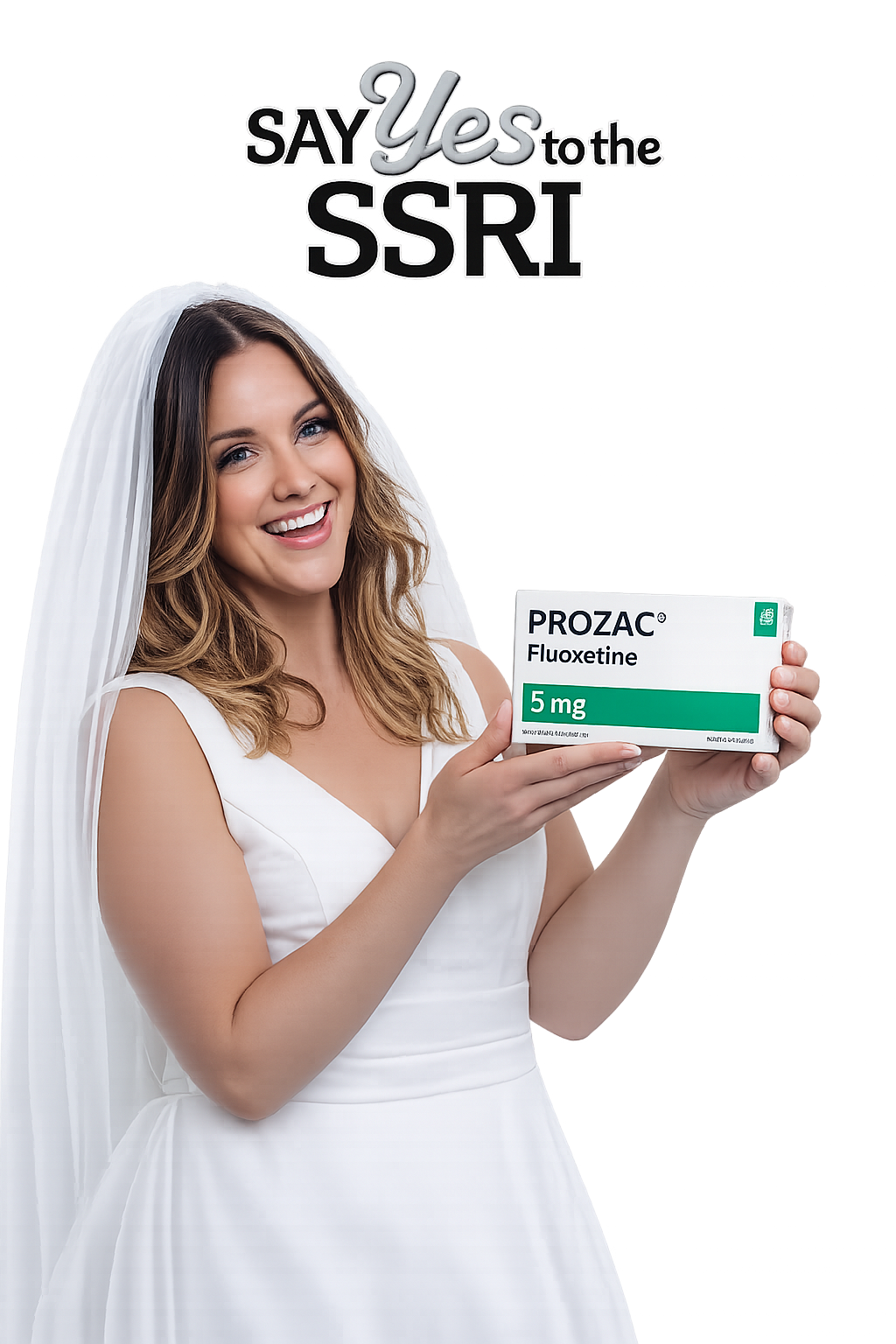
If male readers of this post, and perhaps a few women who’ve withdrawn from public life, wonder where the phrase Say Yes to the SSRI comes from and why it’s linked to a woman in a wedding dress – check out Say Yes to the Dress.
The Good Trips on SSRIs Transcript is here. The GT Video is here and embedded below along with shareable You Tube, Instagram and Tik-Tok clips.
YouTube clips
https://youtube.com/shorts/
https://youtube.com/shorts/
https://youtube.com/shorts/
https://youtube.com/shorts/
Instagram Clips
1. Serene
https://www.instagram.com/p/
2. Goldilocks
https://www.instagram.com/p/
3. Not for severe
https://www.instagram.com/p/
4. Say Yes to the SSRI
https://www.instagram.com/p/
5. Better than well
https://www.instagram.com/p/
TikTok Clips
1. Serene
https://www.tiktok.com/@
2. Goldilocks
https://www.tiktok.com/@
3. Not for severe
https://www.tiktok.com/@
4/ Say Yes to the SSRI
https://www.tiktok.com/@antidepeffects/video/7620955396265676055
Bad Trips on SSRIs
There will be one more post in the series next week:
Consenting to SSRIs
annie says
How the algorithms work for me. I regularly press the YT button on my phone. I don’t have to do anything. On the feed up comes The Telegraph, The Spectator, Douglas Murray, Jacob Rees-Mogg, Donald Trump, etc. etc. Stuff I have an interest in. Scrolling through there was RxISK, under Douglas Murray, No Sex We’re on Antidepressants 75 views 8 days ago. This is the first time I have seen RxISK appear, here..
So all these ‘shorts’ will appear, and go who knows where. A spreading of RxISK tentacles –
Micro-dosing makes sense as SSRIs work on the sensory nervous system and what we don’t want is an SSRI going haywire, and doubling the dose, which happens much too often, is a guarantee to drive your sensory nervous system wild. Too wild and awful things happen. Also, it’s pretty easy to ‘give a short’ to your doctor, or even play them the short and punchy Good Trips on SSRIs, with your phone in your hand..
MHRA will never come up with something like this, they don’t have the ‘gift’. Their ‘eggs’ won’t hatch.
Say Yes to a Dress
Say No to a Woe
Harriet Vogt says
‘What Good Trips brings home is that our issues with medicines – SSRIs in particular – is not simply a matter of transparency about hazards. Potential takers of any medicine need a vision about what a medicine does and its appropriate use.’
As you often say (paraphrase), part of any drug (I hate the informal, implied harmless chumminess of the word ‘meds’ – though know it’s common parlance), is information. So it’s pretty extraordinary that, for example, Prozac (fluoxetine), the world’s most famous SSRI, number 5 best seller by volume in the US, the world’s largest market est 50% volume, comes with added biodrivel – not information.
Since industry and its medical handmaidens/handpersons (whatever) were shamed out of flaunting the ‘serotonin deficit’ marketing reason to believe (aka the RTB), the PIL copy reads more hesitantly, like it’s got a hole in it:
‘How Fluoxetine Capsules work
Everyone has a substance called serotonin in their brain. People who are depressed or have obsessive-compulsive disorder or bulimia nervosa have lower levels of serotonin than others. It is not fully understood how Fluoxetine capsules and other SSRIs work but they may help by increasing the level of serotonin in the brain.’
https://www.medicines.org.uk/emc/files/pil.11909.pdf
The NHS corporate information is equally disinformative:
‘It works by increasing the levels of serotonin in the brain. Serotonin is thought to have a good influence on mood, emotion and sleep.Fluoxetine helps many people recover from depression, and it has fewer side effects than some other antidepressants.Fluoxetine usually takes around 4 to 6 weeks to work.Fluoxetine will not change your personality, it will simply help you feel like yourself again’.
https://www.nhs.uk/medicines/fluoxetine-prozac/about-fluoxetine/
I was thinking – have they just edited out the overt and obviously risible claim of treating ‘depression’ by correcting a fictional ‘serotonin deficit ‘- and left the rest hanging there? When it suddenly occurred to me – oh, I see what they’re doing, they are perpetuating the myth by continuing to allude to it, with added vagueness. This is not editorial faiblesse.
I guess it’s not uncommon in medicine – drugs – to be unclear about precise modes of action. But the very least the human being encouraged to swallow a pill might expect from a prescriber is a notion of what effects they could expect to feel.
Your wholly lucid explanation (memorably, iconically even , visualised in the final slide) – taking the edge of sensory system reactivity – makes total sense of the adverse effects fessed up to in the PIL – (‘common side’ – decreased sex drive or sexual problems, dizziness, change in taste, uncontrollable shaking, blurred vision, rapid and irregular heartbeat sensations, flushing, vomiting, dry mouth, unexplained vaginal bleeding ,feeling shaky..’ etc. etc.),
It will be interesting to see if the next ‘transparent ‘ iteration of the SSRI Patient Information Leaflet is – um – any more transparent.
Dr. David Healy says
H
You say it’s not uncommon in medicine to be unclear about precise modes of action. This has nothing to do with SSRIs. In this case the knowingly sold mode of action is a lie. A lie that is completely at odds with the experiences of people taking the meds – experiences obvious to the person on the med and to those living with or mingling with them. The idea of taking 4 to 6 weeks to work is out there is the earth is flat universe or perhaps a conspiracy claiming we never landed on the moon.
Words fail me – how is it possible for so many people to be so duped for so long?
The next video in the series may reveal something of the mechanics of duplicity.
D
Harriet Vogt says
I think – LIE – may be a charitable interpretation. A modern crime seems more fitting.
I’m sure we all read Patrick Radden Keefe’s forensic ‘Empire of Pain’ with a sort of morbid fascination. I think the estimates are around half a million human beings killed by that modern crime. The obvious lie that Oxycontin wasn’t habit forming. The greed and venality of doctors and desperation of deprived communities where harm was concentrated. though widespread demographically. How many have and are being killed and disabled by this modern crime?
Of course we have come to expect psychopharm wisdom from you (no pressure) – but it is pretty extraordinary that you are literally the only medical/scientific authority who can explain how SSRIs work. Coincidentally, returning to X yesterday, as a virgin stripped of my followers, I came across this MiA piece by Stuart Shipko:
‘The most elegant hypothesis for the cause of protracted withdrawal symptoms has been proposed by Dr. Healy.
https://www.madinamerica.com/2023/10/ten-years-later-still-shooting-the-odds/
The boundaries of MOA sense seem to blur the moment emotions are involved. Which is weird because even us mere mortals know how other drugs like alcohol and caffeine affect our senses and the way we think and feel. But the commercial conceptual ‘brain’ framework seems to have corralled even supposedly critical thinkers. It’s bonkers – just look at the SSRI adverse effect profile and try and explain that only using brain theories. They run out of road.
Peter Gordon drew my attention to a segment on the BBC’s Radio 4 Today Programme – an overview in this article. 70,000 young people under 18 are in the UK are prescribed antidepressants each year. It covers all the predictable issues – escalating ‘mental health demand ‘ vs impoverished supply,
GPs pressured to ‘do something’ given lengthy waiting lists for support services etc. etc.
https://www.bbc.co.uk/news/articles/cgjzwpvy309o
But the two statements in the radio interview that were imo most disturbing came first from the perfectly decent GP who aimed to avoid medicating youth:
‘And these decisions are taken on a very individual basis, based on the young person you have in front of you at that. At that moment, and also with a great deal of experience by GPs who have relevant experience and skills in these areas.’
And next one of the contestants for President of the RC Carpet Fitters , Subodh Dave:
‘So sometimes the focus can come up on antidepressants, which is a validated, evidence based, scientific treatment for depression in adults, in younger people too.’
Modern crimes in medicine are built on just this sort of clinical mythology. A dimension of your ‘mechanics of duplicity’.
annie says
This quite takes the breath away – None, are qualified to give advice. It’s every bit a latch-key to disaster – hence the introductions of the RxISK Series – Snap-Shots you can count on
Indeterminable amount of waffle about Fluoxetine –
https://www.nice.org.uk/guidance/ng134/chapter/Recommendations#care-of-all-children-and-young-people-with-depression
1.6.22
If treatment with fluoxetine is unsuccessful or is not tolerated because of side effects, consideration should be given to the use of another antidepressant. In this case sertraline or citalopram are the recommended second‑line treatments. [2005]
Changing antidepressant represents high-risk management. If Tom Kingston as an adult, resulted in his death, what does it do to kiddies
Children of the Cure: Missing Data, Lost Lives and Antidepressants
https://www.amazon.co.uk/Children-Cure-Missing-Lives-Antidepressants/dp/177705656X
This needs to be on the grid, not off-the-grid. It is astonishingly absurd that all roads lead to the highway and not the byway – capturing the kids early is not success it is abject failure
Dr. David Healy says
The MHRA have a new brief coming their way – which is to make the UK more pharma-friendly – difficult to see how they can fill this government brief and do anything other than what pharma want.
D
admin says
Comments on the Youtube video
@ajax700
• 2 days ago (edited)
Never take them, even on low doses. You can end permanently castrated and/or permanently damaged and neither can’t be cured. And almost all will gaslight you telling you are inventing things. Sincerely, a PSSD sufferer.
annie says
This is what Scotland says – Right Decisions –
High dose SSRIs for the treatment of depression
https://www.rightdecisions.scot.nhs.uk/antidepressants-quality-prescribing-a-guide-for-improvement/target-groups-for-review/high-dose-ssris-for-the-treatment-of-depression/
20mg: citalopram/fluoxetine/paroxetine
10mg: escitalopram
50mg: sertraline
’20’s plenty and 50’s enough’
What does Canada say?
https://time.com/7377687/canada-shooting-tumbler-ridge/
The shooter was on 280 mg. Sertraline (Zoloft). He had previously been on 50 mg. Fluoxetine
New York Post
“I am on Sertraline 280mg (SSRI) …
tim says
Another brilliant, succinct and powerful video.
The entire series provides an invaluable resource for all Primary Care Physicians. They are of great public health, preventive medicine, and quality of care knowledge and skills, which would be invaluable in improving the educational value of Vocational Training In General Practice.
I wish that I could have had these invaluable videos available to me during my own training in General Practice and subsequent specialist hospital training. Our loved one and our family would have been spared 16 years of iatrogenic misery, only eased by the support and comfort invaluably provided by RxISK.
The challenge (which seems potentially insurmountable) is the indoctrination and delusion within General Practice that these drugs, so very dangerous for so many, provide the perfect go-to prescriptions for life’s adversities.
Is there any way that doctors who are ‘expert’ radio and television broadcasters might be encouraged to watch them?
Thank you
Dr. Will Powers says
I’m overwhelmingly pleased to see this, as “harm reduction” strategies have been proven to work. Information is power, and too many organization shy away from the reality that sometimes, people do drugs. Sometimes people do things that the medical institution doesn’t want them to do. But educating patients and helping reduce the possibility of harm is always a better choice than scolding them or pretending like these things aren’t happening everywhere.
I will help a bodybuilder who has atrophied their gonads from years of steroid abuse restore natural function, because i’m helping mitigate harm. That’s not the same as writing him a script for anabolic steroids, and it’s also not “enabling” drug abuse. He has already used the steroids. Whether he will use them again or not is irrelevant. Helping that guy achieve better health is my job. It’s not my job to judge him or deny him care because of my own moral compass.
Harm reduction education has been proven to not increase illicit drug use but rather reduce the complications of it. Well done here.