
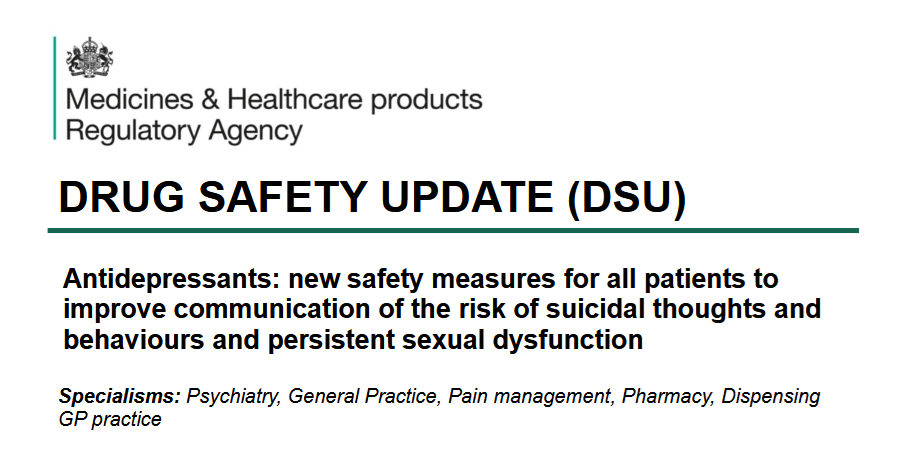
 On 15 October 2026, the UK’s Medicines and Healthcare products Regulatory Agency (MHRA) announced new warnings for SSRI and SNRI antidepressants. These will include a new boxed warning in the patient information leaflet for suicidal thoughts and behaviours, a new patient card, a supporting safety leaflet, and the addition of the term post-SSRI sexual dysfunction (PSSD) in the patient information leaflet.
The full document along with a background research document and ‘Patient Card’ can be found HERE. There is a further post to come on withdrawal – RxISK was well represented at this also.
This post is put together by several RxISK players.
How did this come about?
Back in 2018, RxISK wrote and submitted a petition to the MHRA, the European Medicines Agency, and the US Food and Drug Administration (FDA). We requested warnings about persistent sexual dysfunction to be added to all SSRIs and SNRIs. This was on the back of a new study that we had recently published, 300 Cases. Additionally, we provided a large amount of supporting data to the European Medicines Agency including individual named reports and letters from healthcare professionals. We offered the same to FDA.
It resulted in warnings about persistent sexual dysfunction being added across Europe and the UK. Other countries have since followed suit including Ireland, New Zealand, Canada, Hong Kong, Australia and Malaysia. However to date, the FDA has failed to provide a decision on the petition and did not take up our offer of further information. This is all the more bizarre given that they acted upon our subsequent petition about isotretinoin. They have confirmed to us in writing that our SSRI/SNRI petition is still ongoing and no decision has yet been reached.
Some of us figure MHRA would not have done what they have done last week without getting the nod from FDA. And MHRA have mentioned getting agreement to these changes from almost all the pharmaceutical companies – so let’s see if there is movement on the FDA front soon.
Many people, including us, felt that the 2019 warnings were not strong enough. One problem was that they simply referred to “sexual dysfunction” which was quite vague. Neither patients or healthcare professionals could be expected to interpret this phrase as genital numbness and pleasureless orgasm. It also allowed doctors to continue conflating PSSD with a loss of libido that could be attributed to mental problems. People wanted either the individual symptoms of PSSD to be listed, or the name of the condition, or ideally both.
Since then, many more groups and individuals have attempted to liaise with MHRA to push for stronger warnings, in some cases trying to enlist the help of members of UK parliament. This new development is likely the cumulative effect of these efforts, bolstered by the previous petitions and warnings, as well as the condition becoming increasingly well established in the academic literature. The publication of diagnostic criteria and the introduction of codes from MedDRA and SNOMED have also helped to solidify PSSD as a diagnostic entity in its own right.
In terms of suicidal thoughts and behaviour, SSRIs and SNRIs already carry warnings. However, these warnings generally focus on children and young adults when, in fact, these adverse reactions can affect people of all ages. The current warnings also give the impression that these thoughts and behaviours are an exacerbation of a mental problem you already have. But the reality is that antidepressants can cause suicidal thoughts and behaviour in completely normal people with no history of mental disorders. See Experiment at the End of the Millennium for more about this issue. It’s a fascinating read.
What does this mean?
This will be the first time that PSSD has been specifically named in the patient information leaflet for any SSRI or SNRI in any country, and so it’s another step forward in terms of raising awareness of the condition. But in reality, this development probably means very little and is unlikely to have the effect that some people are hoping for.
It is also difficult to give the MHRA much credit. They have indicated that their first report of a sexual dysfunction continuing after an SSRI was stopped was in 1991. Despite this, it wasn’t until a huge effort by RxISK in 2018 that they added warnings, and only in 2026 that they will add the name of the condition.
It remains to be seen what the new warnings about suicide will say and whether anyone will take notice.
What this does not mean
Part of the push for warnings hinges on the idea that our consent to treatment should be informed. But it is a mistake to think that simply giving a list of problems is going to inform consent.
Taking a drug like an SSRI is like learning to ride a bike. Ideally if you and your doctor agree to go ahead with treatment, you should be given something like a 3 day course of the equivalent of 5 mg of Prozac and asked to keep an eye on how you feel on this. You should ask family and friends to feed back any changes they spot in you. Many of the key changes will be visible in hours or day – genital numbing may be there within 30 minutes.
Then you should stop treatment for 3-4 days before going back to see your doctor – as you will spot effects the drug had when you stop that you might not have picked up while taking it. If after this you think you would be able to live life with genital numbing and muted orgasm like this if it were to persist for the rest of your life, you are closer to having the capacity to consent than you would be from simply reading a list of potential effects.
There is another matter not touched on. In the case of PSSD and both suicide but especially homicide on these drugs, shouldn’t the partner of anyone starting treatment be informed of the potential consequences for her or him?
Humor
The combination of MHRA and AI may bring a smile to your face. If you open the patient card, it is likely AI will tell you it can summarise this for you. AI usually tells us this is a long document and it can summarise it for you. The patient card is not long..
We may not all have the same AI but at its very best AI might save a word or two on the original very few words – at a cost of making if if anything less coherent. AI is definitely giving the impression it is principally concerned to be seen to be doing something in this case (taking you over) rather than interested to add cutting edge value. It’s being a perfect bureaucrat. The original document may well have been written by AI.
Toxicity
MHRA steer a million miles away from branding PSSD as a toxic state. They downplay it’s likely frequency. But more to the point, they don’t tell anyone that there is no research happening on establishing what underpins PSSD or how to treat it, other than the research being done by people with PSSD.
This should be shocking but it’s not. It’s another example of the Dogs Bark, the Caravan Moves on. Back nearly 40 years ago, the companies marketing SSRIs used the injuries caused to thousands by indiscriminate benzodiazepine use as marketing copy for the need to switch from benzos to SSRIs. SSRIs were going to be the proper treatment people should have had all along. But in the last nearly 40 years, no company or government has made any effort to establish what can be done to remedy the enduring benzodiazepine injuries and there will be no effort made to remedy SSRI injuries.
No-one with PSSD should expect, and we imagine few if any do expect, that there will be any support for research to understand what has happened and how to remedy it.
None of us or our doctors will be skeptical of the next generation of wonder drugs – like the Glip1 agonists.
Vortioxetine
When EMA listed sexual dysfunction in small print in 2019, they made it clear this didn’t apply to the Vortioxetine label supposedly because they did not have enough information that it also caused the problem. We had reports from several vortioxetine users back then and have far more now – enough for RxISK to say vortioxetine (Trintellix – Brintellix) causes PSSD.
A likelier explanation for the omission of vortioxetine is that it was then and is still in some places on patent. And both regulators and pharmaceutical companies have a greater felt need to look after the health and wellbeing of pharmaceutical companies than they have to look after ours,
Anonymous
One oddity to the documents is that the members of the expert working group are not named. Why? What those who have been injured by treatment possibly fail to understand is their ‘betters’ are scared of them. They expect social media vilification and worse – not realizing that most of the nastiest trolling on social media comes from senior figures of the medical professions.
The best example of this was Daniel Casey who chaired the 1991 FDA Hearing on Prozac and suicide – wearing a bullet-proof vest under his shirt and jacket.
Chris says
Actually, I do expect there will be research on this. AI/ML is also increasingly in public hands, plus not every health system is privately funded.
Dr. David Healy says
Chris
Research on what – suicidality or PSSD? AI isn’t going to do research. It will be people who do it – and I can see those already affected continuing to do it as they’ve done before AI was a blink in anyone’s eye and they may use AI now but the risk with AI is that you will get locked into an echo chamber
D
Anne-Marie says
I asked ai if ai/ml can predict ssri alcohol cravings. This is what it says below. It looks like it just uses the information already out there. I was hoping ai could think for itself.
Yes, AI and machine learning (ML) can predict the risk and pathways of SSRI-induced alcohol cravings
, though it is an emerging area of precision psychiatry. While some people find that Selective Serotonin Reuptake Inhibitors (SSRIs) reduce their urge to drink, a specific subset of patients experiences an intense, paradoxical surge in alcohol cravings and impulsivity after starting these antidepressants. [1, 2, 3]
AI/ML models do not look at a single cause; instead, they integrate multi-dimensional datasets to build predictive “early-warning” models. AI approaches track and predict this phenomenon through several interconnected mechanisms: [1]
1. Genomic and Molecular Modeling
2. Pharmacokinetic and Exposure Modeling
3. Neuroimaging (fMRI) & Connectome Mapping
4. Digital Phenotyping and Natural Language Processing (NLP)
Summary of AI vs. Traditional Approaches
Predictive Domain
Traditional Approach
AI/ML Approach
Genetics, Brain Activity, Behavioral Triggers
Dr. David Healy says
I’ve greatly shortened this comment as AI spends a lot of time saying nothing and the more time just repeating the more you’d figure its not got a lot to offer – yet anyway. As a tool for someone to guide toward issues that might reveal something it may be more helpful
D
Jo Ann Cook says
The core warning on antidepressants has existed for two decades. Despite this warning a massive campaign took place in Canadian schools in early 2000 instructing children and teenagers to accept the erroneous belief that antidepressants are helpful and necessary to solve life challenges. The result of this campaign is an astronomical surge in student violence. See link below. Yet our educators continue to look for other excuses for this violence, such as more psychologists and social workers are needed.
The industry propaganda fed to students and teachers is that mental health drugs such as antidepressants create successful adult lives, free of auto accidents, school failure, drop outs, divorce, suicidal behaviour, unemployment and criminal behaviour, such as violence. The opposite is true,
Simon Davison, a Canadian psychiatrist and one of the main participants of the creation of a false mental health school curriculum was reported to favour targeting young minds as “they are more receptive to new information”. He was a key player in making “a major move” of ,services, more often antidepressants and other psychiatric drugs into elementary and high schools. His vision of “schools as a hub for the early diagnosis and treatment of mental health disorders” is a reality today. Davidson received funding from Eli Lilly, Pfizer, and Smith-Kline Beecham, now GlaxoSmithKline.
Thank you for alerting readers to the new warnings. This information needs to be disseminated to our schools, The educational curriculum is devoid of any warnings. Our youth are being captured by the industry and are the future enablers of antidepressants in their peers. The exploitation tools even include having students ratting on their fellow students who may have life challenges.
No youth under 21 should be on antidepressants, similar to the restrictions of alcohol. The medical industry is complicit in this ongoing disaster,, making our youth suicidal and increasingly violent in our schools. I witnessed the development of this morally reprehensible trend in our schools and documented its rise in the book Making Healthy Children Sick What the Mental Health Industry Is Not Telling You.
Thank you again.
Read in The Globe and Mail: https://apple.news/ANvbxUeroRkSxBNDiX8Wt1Q
tim says
“Taking a drug like an SSRI is like learning to ride a bike. Ideally if you and your doctor agree to go ahead with treatment, you should be given something like a 3 day course of the equivalent of 5 mg of Prozac and asked to keep an eye on how you feel on this. You should ask family and friends to feed back any changes they spot in you. Many of the key changes will be visible in hours or day – genital numbing may be there within 30 minutes”.
“Then you should stop treatment for 3 – 4 days before going back to see your doctor – as you will spot effects the drug had when you stop that you might not have picked up while taking it. —– ”
What an invaluable evidence-based NICE Prescribing Guideline these words of wisdom would make.
Urgently needed, evidenced, life saving and family suffering preventing SAFETY FIRST PRESCRIBING.
This policy would have saved our loved one and allowed a joyous, gifted and fulfilling life to continue.
Thank you.
If only all prescribers could understand and accept this.
If only all Vocational Trainees in General Practice could be taught this.
Mrs Fiona Mills says
I was on Lithium therapy for nearly 25 years for the treatment of diagnosed bipolar disorder. I was repeatedly told of the dangers posed by falling outwith the very narrow therapeutic range and the necessity for regular blood tests and immediate action, particularly if blood test results came back higher than the top end of the range. Last year, I unintentionally lost 14kg in weight, which altered my serum levels of lithium and thyroxine. My medical practice failed to alert me that I had thyrotoxicosis and a few months later, that I was above range for lithium. I had lithium toxicity symptoms. When I phoned to find out my blood test result, I was told that I was slightly above the normal lithium range but the doctor was not concerned so no further action was necessary. I had to call back to ensure that I had symptoms of toxicity and that I should have been approached to verify the existence of toxicity symptoms. An unapologetic GP simply told me to decrease the dose, repeat the blood test in a couple of months to “see if I was still within the therapeutic range” There was no mention still, of my thyrotoxicosis status. Furthermore, over the course of the previous 5 years, I had requested cessation of lithium therapy as I had never felt any benefit and actually believed that it was doing more harm than good. Warned off doing so, every time. Also during the whole lithium therapy, I was also given many different SSRIs, changing each one after perceived benefits were short lived or non existent. I lost track of how many times I dipped into suicidal ideology and the number of intentional attempts at ending my life. From the age of roughly 33 to nearly 55, I was an in patient at a psychiatric hospital well over 20 times, ranging from a few days to 6 weeks. Earlier this year (2026), I made the decision to titrate myself off lithium. ONE week post lithium, I thought a miracle had happened. Lack of energy, crippling fatigue, brain fog, a new vastly improved clarity of thought, suicidal ideology completely vanished, libido returned, the constant heaviness that had weighed down on me was gone. ONE week! Even while recovering from a now full blown endocrine/metabolic crash, present but not reported to me before I stopped taking lithium, I still felt so much better and could think clearly enough to pursue a referral to an endocrinologist to sort out the clinical mess I was in. I then titrate myself off the SSRI Escotalopram, which I had been prescribed on and off for about 2 years.
Yes, I agree that honest labelling on these powerful psychiatric drugs is absolutely necessary, I feel that monitoring individuals and actually taking on board an individuals concerns about any aspect of use of these therapies requires investigation. I feel failed by a system that was supposed to protect, treat and monitor me. I was allowed to become seriously ill with no intervention. Any concerns I raised seemed to be dismissed. More frustrating is the fact I have a degree in physiology and a masters in analytical chemistry and had started a career in research and development, to which medicine was interwoven. I believe that my expertise in research saved my life. And yet, no one would have an honest conversation with me. Oh and at age 53, I was finally recognised as being high functioning autistic, something I had voiced for over 20 years. Both grown children have autism and autism is in my family. Perhaps it’s time to start listening more to what patients have to say? And not just reach for the prescription pad to offer another powerful, potentially damaging or life threatening drug while leaving that person to carry on, business as usual, without adequate or any boots on the ground support and put the onus on us, who are already under extreme mental health pressure, to somehow negotiate a hostile system, which is difficult enough to access as it is, to report any symptoms, concerns or simply have questions answered honestly and in a timely fashion.
I may not have been around to post this, many times. I survived to tell the tale. I’ve lost close friends to suicide and nearly lost friends to, in my opinion, medical negligence. So who’s next?
Mason says
-“One oddity to the documents is that the members of the expert working group are not named”
I had noticed the same here in NZ, and, while they are named, the minutes lack details of what happened. When reading through minutes from the 1990s, each person is named, each person has what they said, each person has the position they voted on and why. Now its just “The committee voted against” or “The committee agreed”.
It is really valuable to know why they disagreed or agreed with something, and if anyone else brought up arguments for or against – this used to happen.
Its as if its designed so that when you ask for why something was agreed such way, that information does not exist. The only information that exists is the outcome.
Dr. David Healy says
Did you not believe that these ‘experts’ are scared silly of being mugged by the people who they think nothing of keeping in the dark?
I’m reaching for but not quite finding a parallel with pharma – who profess to put patient safety and wellbeing above all other considerations when they are really putting the health and wellbeing of the company above all other considerations. If only psychiatrists acted the same way – putting the health and wellbeing of the profession above all other considerations and this led them to warn us that these drugs are dangerous and we need doctors to keep us safe. At least pharma has some whistleblowers and leakers of documents from whom we learn more than from any clinicians
D
Harriet Vogt says
If you look on pages 45/46 this seems to be the membership of the Antidepressant Risk Minimisation Expert Working Group (ARMEWG) or ARM EarWiG (my mnemonic). https://assets.publishing.service.gov.uk/media/6a5a1cdf7eb057103bd94678/HMR_Advisory_Bodies_Commission_on_Human_Medicines_Annual_Report_2025.pdf
You’ll likely know them all – I can spot one decent patient safety centric individual whom I actually know – and then a sort of spectrum of political opinion. It’s surprising that the Patient Safety Commissioner isn’t included. It’s also significant that there’s not one single expert in communications, effective safety communications being the stated objective of the review. But, as the MHRA also state firmly in the Public Assessment Report (PAR):
‘PILs are statutory documents, owned by the relevant marketing authorisation holders (MAHs). Their format is defined in legislation, and the content of each PIL is approved by the MHRA. This regulatory framework is important to understanding both the opportunities and limitations for updating safety information within PILs.’
https://assets.publishing.service.gov.uk/media/6acf6ab62de3184ccf8b80f2/PAR_Antidepressant_EWG_Review.pdf
Since it’s common knowledge most patients don’t read PILS, nor doctors SmPCS, this core aspect of the project seems to be mostly an exercise in political – and one assumes legal – bureaucracy, made impossible to dodge any longer by Rxisk. Time to come out with your hands up, FDA.
I trawled through the ‘PAR’ There are some sensible ideas – cf isotretinoin and finasteride – safety cards on/in pack, a separate safety leaflet (MAHs not involved in writing), Dear HCP letter, ‘stakeholder comms alignment’ ,shifts in clinical practice (how?) – as well as warnings across all age groups (not just <25) and indications.
They’ve also taken up the idea of having the patient’s ‘trusted person’ in the loop – which slightly aims off for Bob Fiddaman’s wise survivor warning that patients rendered suicidal by these drugs are incapable of the wholly rational behaviour assumed by the guidance.
Oh, and the mythical ‘chemical imbalance’ claim has finally bitten the dust- decades late. Miracles do happen.
But the political tensions within the EWG are obvious – and risk undermining safety communications. For example, this nonsense – that was thankfully overridden:
‘Members expressed concern that introducing boxed warnings could discourage some patients from seeking or continuing treatment and might inadvertently increase the risks associated with untreated depression’.
The proposed suicide prevention patient card is also imo dangerously confusing.
Patient Card
• This medicine is an effective treatment but can take time to work.
• You may experience some side effects before your symptoms improve
• Please read the leaflet provided in the box of your medicine for more
information
Warning- Thoughts of self-harm and suicidal behaviour
• Do not suddenly stop taking this medicine without talking to a healthcare
professional
• Tell someone you trust you are taking this medicine
• Ask your trusted person to read the leaflet
• Contact your trusted person or go to a hospital or call NHS 111, or your local NHS mental health crisis team, if you have new or worse thoughts of harming yourself'
Leading with the ‘ effective treatment takes time to work’ research artefact, but then advising you in the same breath (assuming you are still fully rational and in control) to contact your trusted friend if you have worse thoughts of harming yourself, not to stop taking the pills without talking to an HCP etc. (Isotretinoin and finasteride cards both advise to stop taking the pills).
The glaring omission is what action is the HCP going to take if a prescripticidal patient makes it to them in desperation?
Public recognition of ‘PSSD’ is a big breakthrough – not just in awareness but obviously validation for sufferers dismissed by their doctors – and regularly psychologically abused by senior medical academics on X. No patient safety card for them, though, because ‘magnitude’ is unknown. PIL fomat rules trump potentially lifelong disability risks.
I could go on – but I won’t.
Dr. David Healy says
H
This is fabulous. Well done for finding the membership of the group. This corner of the MHRA you have found seems to speak to a reorganization of MHRA that few of us have been aware of. This in its own right gives a lot of food for thought – way beyond the membership of this particular working group.
The Antidepressant Working Group doesn’t look too bad as you note. Prior MHRA working groups have featured a lot of people with significant industry contacts. But as you’ve noted given the PIL and everything else are essentially documents owned by the Marketing Authorization Holder (the pharmaceutical company) and the groundrules are set by companies the system can afford to have somewhat more seemingly independent EWGs.
My point about the paranoia of those at the top still holds. The best symbol of this is Daniel Casey wearing a bulletproof vest at the first FDA EWG on antidepressants and suicide.
Your comments about the PIL are also great – right through to the I could go on – but I won’t. A lot of the wording is still terribly dangerous.
D
Harriet Vogt says
On reflection, what I should have gone on about are the insights and recommendations for action proposed by the patients and those bereaved by prescripticide who, I was about to say participated in, but I think gave evidence in this SSRI comms safety review is more accurate. Tbf the MHRA did listen.
They are well worth reading in full. SSRI induced suicide survivors and bereaved families’ comments are on pp 9-11 of the PAR, observations from Team PSSD (UK) on pp 18-20 of the document.
https://assets.publishing.service.gov.uk/media/6acf6ab62de3184ccf8b80f2/PAR_Antidepressant_EWG_Review.pdf
Some quotes to give you a flavour of their thinking – and how far it seemed to influence EWG decisions:
SSRI induced Suicide Prevention
‘It is morally and ethically wrong to base risk communication decisions on concerns that a patient won’t take antidepressants if they need them’.
(Morality and ethics don’t seem to be perceived as relevant).
‘There is no empirical evidence anyone reads the PILs and they are written in an unhelpful way like the “may contain nuts” warnings on food labelling, therefore warnings should be on the outer box’
(Acted upon in the form of portable card).
‘Patients should be provided with information before the decision to prescribe. An antidepressant should never be prescribed at the first appointment and patients must be given written information to take away and confirm they understand the risks’.
(Action is the corollary of information. The PAR recommends providing an info leaflet at the first consult – not this refinement).
‘When patients present with worsening symptoms, it is often seen as a failure to respond rather than an adverse reaction to the medicine, so the medication dose is increased or switched’.
( Pivotal – not addressed. Your – ‘try and test’ 5mg week – could be a life saver and actual informed consent.)
Patients and families should be allowed to be part of the EWG
(They weren’t).
PSSD
‘There is a lack of awareness amongst prescribers of the term Post SSRI Sexual Dysfunction (“PSSD”), and many doctors dismiss patient concerns or attribute their symptoms to underlying depression or anxiety.
‘There is no mention of the risks of “PSSD” on the NHS websites or any NICE guidelines.’
(Acted upon – 35 years after the condition was first identified, 8 .5 years after the Rxisk Petition).
The irreversible nature of the condition “PSSD” is not currently clear from the PIL warning and that this must be communicated/ Patients must be informed about the lack of treatment options.
(Currently side stepped in proposed comms – ‘Rarely people can experience more persistent sexual side- effects after they have stopped taking SSRIs. The term post SSRI sexual dysfunction (“PSSD”) has been used by some people to describe these symptoms…More research is needed…)
‘Written informed consent or an acknowledgement of risk form is the best way to record patients have been informed of the risk of “PSSD.”
(Nope. Refused ,as with suicide prevention, imo spuriously. Grounds: absence of clear legal basis, ‘a standardised acknowledgement form may not adequately address the individual circumstances, concerns and treatment considerations blablabla, could be perceived as transferring responsibility for prescribing decisions from the healthcare professional to the patient.’). It’s about ‘shared responsibility.
‘There should be a study to track patients on SSRIs to identify those who develop the condition of “PSSD” and any common risk factors or treatment./ Diagnostic tests should be developed to predict which patients may develop “PSSD”’
(The only proposed research is ‘Clinical Practice Research datalink (CPRD) study to generate data to bridge gaps in information on the risks identified in the literature search, and to serve as a platform for monitoring the impact of regulatory action’.) ‘Magnitude’ and the commercial spectre of ‘unintended consequences strike again.
Your example of Daniel Casey’s bullet-proof vest says it all really. I gather under his ‘leadership’ recognition of SSRI induced suicide and violence was delayed for at least a decade.
Imagine how safe patients could be if their experiences of these drugs were used as the foundations for informing other patients and medical guidance,,,
Dr. David Healy says
This is fabulous digging. Thanks so much for unearthing it and posting all this – plus adding your comments
David
Richard says
We were one of the bereaved families who submitted evidence to the MHRA., in July 2025. This was done
through the officials rather than directly to the EWG members. However, we were given a fair hearing and a chance to comment on minutes, etc.
Sadly, although MRHA have acknowleged some of our concerns over information provision, the involvement trusted family members, PSSD, improving withdrawal services, etc, it does all rather smack of business as usual.
How many members of the EWG really still believe that:-
“For the vast majority of individuals, the benefits of ADs outweigh the risks”….or “The aim is not to discourage use, but to improve the prominence and clarity of the existing warning.”
We are not seeing any message that these drugs should be used with greater caution and rarely as first resort. Also nothing much about the suspicion that current dosing guidelines and or dose increments are far too high for many people. Nor the fact that many of these serious side effects can rapidly emerge in normal volunteers.
We also know that the advice that you should not stop the drugs but return to the prescriber, in the event of them not suiting you, can be catastrophic. You may well be advised to power on for the expected benefit, have your dose increased, be switched to other similar drugs or have have additional benzos or “mood stabilisers” added, often without much continuity of care.
We also believe the magnitude of risk continues to be underestimated, as coroners fail to pursue the drug histories in many suicide (or homicide) inquests and various unwanted effects are attributed to the “illness” rather than the treatment.
Most of our evidence was based on what had happened to our late daughter, but we finished with a more general observation:-
“Finally, the main issue is that we believe far too many people are prescribed these drugs and stay on them for too long, without an informed understanding of their potential risks. This could be conceived as a huge unplanned public health experiment, perhaps partly an unintended consequence of mental health awareness campaigns.
We are all in favour of improving mental health but doubt this will be achieved by giving extraordinary numbers of people dubious mental illness diagnoses and risky psychotropic drug treatments over long periods. This is particularly important in young people who have a lot to lose,”
Whether this MRHA report will infuence the prescribing habits of GPs or the expectations of their patients remains to be seen. It would be good to see a response from the RCGP, representing 54,000 members
This is a recent article in Pulse, a magazine for GPs
https://www.pulsetoday.co.uk/news/clinical-areas/mental-health-pain-and-addiction/gps-to-advice-about-suicidal-behaviour-risks-when-prescribing-antidepressants/
Dr. David Healy says
Richard
This is a marvelous comment. Thank-you. It captures many of the problems of our unsafe safety system – which is really not even a little bit safer after this 2 year think-in.
People like you should not have to learn these bitter lessons through the loss of a fabulous daughter – someone we could all have benefitted from being able to meet. Its not just you and your family – this is happening at scale. But a lived experience like yours, even when happening at scale, seems to make little difference to those whose primary job is to shuffle paper and where indicated to pick safe panels of experts
David
Jonathan Herbert says
“There is a further post to come on withdrawal – RxISK was well represented at this also.”
Curious to know when the post on withdrawal will be published…?
Are they going to update the Patient Information Leaflet again to incorporate withdrawal information or is it going to appear in the additional safety leaflet that is due for publication in 2027?
Dr. David Healy says
Hopefully someone will spot your comment and respond
D
mary H. says
As far as I know it should appear very early next year. There were, apparently, consultations with professionals, another with withdrawal sufferers and a further few meetings with individuals, which took place this month. They hope to have combined the outcomes from all meetings by November and then, I guess, the team will share their thoughts and findings with the full MHRA team ready for publication in the new year.
I suspect this could be an additional leaflet in the relevant drug boxes.
mary H. says
I have just re-read my comment above and realise that I make it sound as if withdrawal will be included in the PIL early next year, that was not my intention. The working group should have their document ready to go by “early next year” but, as we all know, that is just the beginning of the journey towards being in the prescribed drug boxes! Had I put a comma between “publication” and “in the new year” I guess it would have been clearer.
That is what happens when you write a comment, in your second language, in a rush! My apologies.
Richard says
David
We are grateful for your tireless efforts to enlighten us about the history and true state of affairs surrounding these drugs, in the face of continuing headwinds from companies, officialdom and professional bodies. We also appreciate the connections to other people who have had similar things happen, which helps to mitgate the sense of isolation that many of us otherwise might feel.
Perhaps, as the sum of anecdotes continues to accumulate, the tide will turn on the more dangerous SSRI prescription practices.
Dr. David Healy says
The force most likely turn the tide on SSRIs is the pharmaceutical industry. If they have a new more profitable drug to displace SSRIs with, they will actively market SSRI hazards.
But this won’t turn the tide on prescribing practices – the only thing likely to change that is medicine going out of business or recognizing that they will be out of business if they continued to contribute to the lethality of medicines – offering a figleaf for companies and regulators in the process
D