
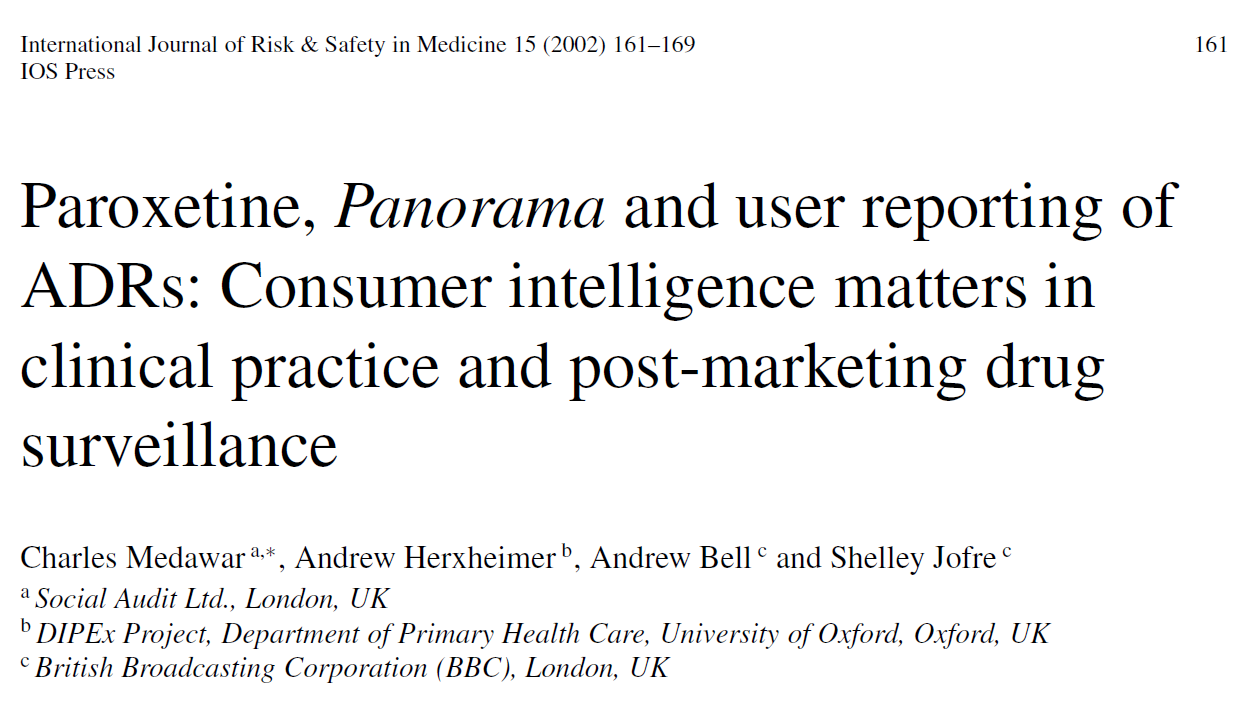
Twenty four years ago, after a Panorama program, The Secrets of Seroxat (Paroxetine), the BBC was flooded with nearly 1400 emails, then a new way to communicate, about your experiences on SSRIs.
This led to a follow up Panorama program – Emails from the Edge – and then two more follow ups. Your emails outlined your experience with suicidality and dependence on SSRIs. In fifty years before that, Panorama had never repeated an issue.
Charles Medawar and Andrew Herxheimer, consultants to the program, sat down and analyzed these emails, along with nearly a thousand other emails on an antidepressant website centered on SSRI dependence. They concluded your emails were richer in detail than standard medical reports to regulators on the same problems. They also thought – back then – the Internet might be a liberating, democratic force. There is no hint they figured it might become a source of growing conformity – a force to Stepford us, or transform us into Handmaids. Their article Paroxetine and Panorama is here.
Just this month, Norwegian researchers have rediscovered the same thing – without being aware that this has all been done before – see Norwegian RxISK.
Lots of innocent people ending up incarcerated in jails or hospitals need your input on SSRIs. Read the vignettes below and send in as many related and perhaps differing accounts as possible.
These two articles add more vignettes. Antidepressants and Violence was published in 2006. It focused on the ‘science’ with the cases in an Appendix. I now realize your cases are the science. The so-called data could have been put in the Appendix.
Antidepressant Induced Suicidality outlines the transformation of two healthy volunteers put on Zoloft into women capable of suicide and perhaps homicide.
Delirium
Had Katinka Newman killed her two children when she thought she had – see The Troubled Dream of Life she would have had a perfect Not Guilty by Reason of Toxicity (NGRT) defense. Delirium is an absolute defense against Guilt. There are many other cases like this but medics are likely to misdiagnose delirium as psychosis and lawyers have no idea about what delirium is. All they see is an unreliable historian which for them is a kiss of death to the case rather than a Get out of Jail Free card.
Personality Change 1
In 1990 Martin Teicher and colleagues reported suicidality emerging in 6 patients taking Prozac and linked this to akathisia. Three years later in a Further Article they discussed several other routes to suicidality including a transformation into a borderline personality.
Personality change is not unbelievable. Listening to Prozac also came out in 1993 claiming dramatic personality changes on treatment, including switches from homosexuality to heterosexuality. Roland Kuhn describing the discovery of imipramine, also a serotonin reuptake inhibitor, in 1958 said the same thing.
Our personalities are largely reflex based – our typical automatic responses are the major shaper of our personalities. Character is not the same as personality. And our reflexes are driven by sensory inputs on which SSRIs work. Rosie Meysenburg created SSRI Stories in part because it was clear to her that the change in people’s personalities made it easy to spot who was on an SSRI.
Personality Change 2
In our healthy volunteer study, one of the volunteers, a remarkably easy-going and friendly woman, while her mother was looking on horrified assaulted a young man whose driving was annoying her, surviving perhaps because he was so taken aback at this reversal of gender roles. A few days later she was actively thinking about hanging herself but told no-one because despite working in a psychiatric unit and knowing she was testing an SSRI, she believed she’d be locked up if anyone knew the thoughts she was having.
There are several SSRI Stories (which we hope to resurrect soon) posts linked into these issues. SSRIs and Violence, SSRIs and Different Violence SSRIs and Research on Violence.
Personality Change 3
In addition to the above there are a host of posts on SSRIs and marriage busting, with the partner left behind certain that what has in fact happened has been driven by a change in the personality of their partner. While sometimes an SSRI may enable a person to do the right thing, there unquestionably are also cases where it looks more likely that the drug has caused the problem – as the Consent to Waltz post hints at.
There are a series of cases involving female school teachers who have taken sexual advantage of teenage males where the courts have implicated the antidepressant she has been taking – see Notes on a Scandal.
There are the likely tens of thousands of cases who have been driven to drink or consume other substances by SSRIs – that we know about thanks to your input. See Alcohol a RxISK Triumph . In these cases SSRI driven alcohol intake have led to manslaughter cases through drunken driving.
Personality Change 4
This section reprises some of the points above and brings in an insight from someone who has a lot of experience based input to the thinking behind the issues. One of the consequences of muting sensory input is not just that images can become dominant as outlined in The Troubled Dream of Life but also a combination of on the surface highly charged and meaningful drivers of behavior (beliefs?) along with a risk of flipping not infrequently from one highly charged motivation to another – leaving the first behind on the scrap-heap.
This is very close to a description of a borderline state. See the healthy volunteer description below.
The cases that best illustrate a reversion to a normal not believing too much in anything are the SSRI induced Alcohol Use Disorder cases, where for most of those affected the person very clearly returns to ‘normal’. There may be some people where the return to normal is more complicated.
Automatism
SSRIs can abolish pupillary reflexes making it dangerous to drive at night as your pupils will not constrict and you risk being blinded by oncoming car headlights. They can also make your vision two-dimensional so you do not see through to the consequences of going too fast on what can seem more like a computer game than real life, especially at night. Famous for making you unable to cry, SSRI are also the drug most commonly reported to FDA as making you cry for no apparent reason – as wonderfully also reported by Bruce Springsteen in Homicide.
These reflex based changes are all automatisms. Automatisms can give you a defense against a guilty plea in the case of manslaughter at the very least and perhaps homicide. They can be present for weeks on end rather than just for seconds.
Neurologists, psychiatrists and neuropsychiatrists have difficulties with the idea of an automatism – variously talking about sane automatisms, insane automatisms and non-insane automatisms, when all that is involved are altered reflexes and SSRIs alter reflexes. These are not side effects. This is the core action of these drugs.
Everyone who takes an SSRI or SNRI and often tricyclics and other drugs has some alteration of their reflexes – the question is whether this is intense enough and prolonged enough in the circumstances of the case to provide a defense. In the case of the person above, who had a crash at night it did – but his lawyers didn’t listen.
Automatism and Substance Abuse
One of Your insights RxISK has facilitated has been the link between SSRI intake and alcohol, and perhaps other substance abuse, now recognized in Canadian Guidelines – see Medical Triumph.
Is this an Automatism? What SSRIs do is mute sensation. One of the sensations muted is the effects of alcohol. People simply don’t register they are getting drunk in the way we normally do – and then they suddenly black out. See – Lonesome Heroes. This potentially opens a door to a defense against alcohol related felonies.
See the passage below from a healthy volunteer on SSRIs who was able to distinguish between the old me and knew how she would react – and a new me who was not conforming to social rules or hadn’t relearnt how to – developed the capacity to – conform.
This is a scenario where some people on SSRIs can literally see themselves becoming a Borderline Personality.
Bill James a key player in RxISK seems to have found it hard to distinguish between a physical delirium which up till 1800 in English at least was referred to as a frenzy – the raving mad – and might today be thought of as a cognitive frenzy – and what he not unreasonably views as emotional frenzies. Do they not warrant being the basis for a Not Guilty verdict.
Well this point from Chris (see the first comment below) and Bill and Peter another person who has had a huge input to this post does bring all of that into the medico-legal frame.
Physical frenzies are an unquestionable basis to a Not Guilty Verdict but what about Drug-Induced Emotional Frenzies?
Trance
Deirdre Morley, who was on an SSRI – See The Eclipse of Us – talking to a policeman shortly after killing her three children said:
I was thinking I wanted to stop, that I didn’t want to do it, but I had to.
Why did you have do it? he asked
Because I had started it – I can’t explain it.
Another of our healthy volunteers, a doctor taking a low dose of Zoloft, outlined in the article above, said on day 11:
I felt like I was spiraling out of control. I started to write things down and then very abruptly there was nothing. My mind was almost numb. Everything seemed to have disappeared, I don’t remember being able to see anything in the room. I knew with absolute clarity and certainly that I had to go through door out to the road and wait for a car. It had to be very final. Yes it would be violent but that was vital and necessary.
I was incredibly calm and peaceful, not because I wanted to but because I knew I had to. There was no choice. It was so simple. Obvious. Irresistible. It was almost like being in a sort of trance or hypnotic state.
Then I was phoned. The spell started to break. If I hadn’t been, I wouldn’t still be alive, and my family would not ever have known why.
Someone else I met recently when on an SSRI found himself standing on a ledge on the open top of a tall building looking down and feeling peaceful that he was about to put an end to the misery he was going through, when a car horn began to blare and getting louder and louder broke the trance he was in. Just like our medical volunteer, his family would not have known why either.
Intrusions 1
Lindsay Clancy appears to have had what are variously called intrusive thoughts and/or command hallucinations.
I was called to see a 80 year old man rehabilitating more slowly from a minor stroke than his doctors thought he should be. Doctors commonly think stroke patients are depressed and they for psychiatric input after starting the patient on an SSRI.
The man didn’t seem depressed to me. He was not doing push-ups as the stroke team might have liked but he was in a good mood. I stopped his SSRI, partly to check if off them he was depressed. A week later I came back to see him. He was even better, more alert and engaged. I was about to leave, when he put a hand on my arm and said – ‘I need to tell you one more thing’.
Pointing to a man in a bed across the room, he said he had no idea who the man was. He had never seen him before. But on those pills, he was having impulses to get up during the night and go over and strangle him. He had no idea why. ‘Those thoughts have gone since you stopped the pills’.
Intrusions 2
Many normal people have hallucinations on falling asleep (hypnagogic) or waking up (hypnopompic). These can be visual, auditory, tactile or indefinable and vivid to the point of being mistaken for reality. These sleep phenomena are related to lucid dreaming, where the person experiences themselves as awake rather than dreaming.
A very normal 30 year old woman consulted me. From time to time she had these experiences on falling asleep, which were not disturbing. During a period of stress she was put on mirtazapine often used as a sedative in lieu of hypnotics. Mirtazapine is not an SSRI but it acts on the serotonin system.
Since starting it, on sinking toward sleep she was now having repeated horrific imagery of a a metal grid on a spring, with razor sharp knives sticking out it. As she sank into sleep the grid sprang toward her, looking as though she would be impaled. While she accommodated to some extent, knowing she was still alive, it was impossible to fall asleep. The problem stopped when mirtazapine stopped.
Intrusions 3
A young woman withdrawing from Prozac, navigating a dark room at a party had to step over strangers to get to the bathroom. A violent impulse to assault one of them took her breath away. This returned at regular intervals over the next 10 years causing her to panic every time. It took a decade to stop panicking. It took a further decade to tell anyone about it but when she did, the person she told who had also stopped an SSRI reported a similar thing. There are aspects to what she experienced that are still so disturbing, she has still told no-one.
Intrusions 4
A marvelous grandmother looking after a grandchild had been put on an SSRI for pain relief. We were friends before that which may have made it easier for her to tell me she had intrusive thoughts of harming the child bad enough to remove all knives from her house. Luckily I didn’t increase the dose of the SSRI. There are behavior therapy approaches to intrusive thoughts in OCD, which it is now clear this wasn’t – it was much closer to Tics. Telling her to imagine putting the baby on the kitchen table and choping it up with a cleaver in her case forced a development of the capacity to manage these intrusions.
Commands 1
CP was a 12-year-old, 5’2” boy with considerable family dislocation. Despite these difficulties, he had no record of violence or behavioral disturbance. Following an argument with his father, he ran away and was admitted to a behavioral center where he was started on paroxetine. His behavior worsened. He was discharged against medical advice to the care of his grandparents, who, when his paroxetine ran out, took him to their doctor who prescribed sertraline 50 mg and 3 weeks later increased this to 100 mg.
On sertraline, CP was involved in aggressive incidents at school, the first on record for him. On the day of the killings, his grandparents told him that he could not take the school-bus following an episode of aggression toward another boy on the bus. He attended choir practice with his grandparents that evening, who in response to his restlessness in church said he might have return to his father.
That night CP reported: “something told me to shoot them”. It was “like echoes in my head saying ‘kill, kill’, like someone shouting in a cave”. This began after he went to bed. He had never considered harming his grandparents before nor heard voices. The voices bothered him so much that he got up and stating he couldn’t control himself, he shot his grandparents. He reported the voices stopped after that.
Commands 2
SC 21 years old, grappling with college exams, a house move, and a new partner, went to his family doctor and was given prescriptions for two SSRIs in sequence. He overdosed on each after a few days and was then given paroxetine. Increasingly agitated he asked “what is wrong with me?”
One evening both he and his car went missing. After midnight, he was refused help at the local psychiatric unit and shortly afterwards drove his car through the glass entrance into the foyer, got out of his car and lit a cigarette.
Back home his parents were alarmed at how angry and unstable he was. He frequently disappeared. No one consulted, including the mental health services, mentioned his medication.
He was having rage attacks where he paced and shook and screamed for help, then would quieten down, until the next wave came over him. He alternated between seeking help, with some relief if help seemed to be on the horizon and then a depressed state when he would say “They’re not going to help me are they”.
One evening he seemed to be losing control in waves every twenty minutes or so, each lasting maybe ten or fifteen minutes. He asked to be kept safe whilst saying the next wave was coming and then totally losing control. He was taken to a psychiatric unit where for the first time, he mentioned voices that seemed to be controlling him. These had appeared 3 months before on starting on paroxetine. The voices said to get rid of everyone who was letting him down. Asked if he was obeying them, he said “I try not to but it’s getting harder”.
He was jailed for a year for driving through the doors of the psychiatric unit. Over the following decade he was given multiple diagnoses, including bipolar disorder, and put on antipsychotics. None helped. He began to improve when the diagnoses were jettisoned and the medication reduced to almost zero. His voices persist 25 years later but he learnt to manage these in a Hearing Voices group. He is now a Church Verger among other things.
Commands 3
The couple were more than usually well-heeled. When wives come to consult, I don’t let their husbands in. But he insisted she wouldn’t tell the truth unless he was there.
The story of her life was unremarkable. There was no good reason for her to be put on venlafaxine. But she was. Tell him what happened, her husband said.
She told me, she had taken off all her clothes in the hallway of their house, opened the front door, walked out and stood naked in the middle of a busy road. Why did you do that I asked. A voice told me she said.
Sleep Walking
There have been several bizarre sleep-walking incidents, several lasting hours
One involved a 20 year old who had developed narcolepsy 4 years previously, a condition characterized by automatic behaviors, especially at intervals between waking and sleep when subjects can appear to function but are close to sleep-walking. One of these automatic states, cataplexy, produces collapses. The standard treatment for cataplexy is low dose of a serotonin reuptake inhibitor. He was put on too high a dose of venlafaxine which helped his cataplexy but caused teeth grinding, nosebleeds and sexual dysfunction. His doctor agreed to swap him to a low dose of another drug.
Unaware venlafaxine causes withdrawal, he stopped it abruptly and had aggressive and automatic behaviors that neither he nor his parents linked to withdrawal.
After a week, he appeared in the family kitchen with a bag on his shoulder. Speaking oddly, he walked out and went to a petrol station near his home along a route where he was likely to meet or be seen by people he knew to a place where he was known, in broad daylight, wearing distinctive clothes. He took out a knife while there, as recorded on CCTV. He has no recollection of this.
He walked away from the petrol station on a route that left him obvious to anyone at the petrol station who had just seen him, making no attempt to conceal himself or his whereabouts. He was detained by the police who wondered if he was on drugs. Later, when interviewed by his lawyer, he was perfectly normal.
The charges against this young man were dropped when both prosecution and defense experts reported that but for the combination of narcolepsy and venlafaxine, this event would not have happened.
SSRIs are the drugs most commonly reported to regulators as causing sleep walking and violent nightmares.
Akathisia
It’s not enough to mutter akathisia to get a verdict. The question is how might akathisia or the combination of akathisia and sensory muting actions of SSRIs shape our Capacity to tell Right from Wrong or our ability to Conform our behavior accordingly.
Would this account from the doctor whose trance was broken by her pager going off help a juror grapple with the issues?
It feels like inside my head there are 2 people. The “old me” and someone else like me but unpredictable. The “old me” is aware of everything happening and what I should do, how I should react but is powerless and can only watch what the “imposter” is doing. It’s like the self-control part has been removed or the connection between conscience and actions cut off. The bit of me that seems to be in control is like a child; easily moved to emotion, gullible, aware of expected social etiquette but not inclined to follow it, impatient and irresponsible.
I can understand how people become deluded and have strange thoughts. If I didn’t know all this was due to pills, I’d be looking for another reason… God, aliens whatever and wondering if they were manipulating my thoughts. If this happens to you for no apparent reason, you would desperately find a cause no matter how improbable, for what you were experiencing, and how you would have to fervently believe it to be able to go on.
Anticonvulsants/Mood Stabilizers
A patient I saw had a febrile seizure when young and was later thought to be having absence seizures. He was put on a now rarely used anti-convulsant – clobazam. This helped him. For over a decade, he appeared to have no problems. He was able to start university and do well.
A year later an episode at university left him slightly paranoid. When he came home to visit his parents, they took him to a doctor, who added a low dose of amisulpride ordinarily thought of as a rather clean antipsychotic. The young man became more paranoid and started to show catatonic features. This led to further assessments in clinics and an admission to hospital. The doses of his antipsychotics were raised and clobazam was replaced by more standard anticonvulsants like valproate.
He started having violent out of the blue episodes and was moved to a secure ward, put on one to one supervision and confined to one room for close to seven years. The treatment remained the same throughout – antipsychotics and anticonvulsants. He was switched to a medium secure unit, where the antipsychotics were stopped and the violent episodes improved. The anticonvulsants were switched around but there was no return to clobazam. The neurological services didn’t use it anymore and had no rationale for returning to it. The fact he’d been on it for a decade and done well didn’t seem to count. After more than a year, the MSU now plans to reintroduce clobazam and stop all other meds. Watch this space.
Anticonvulsants like Keppra – levetiracetam are infamous for causing rage attacks. Others like lamotrigine and zonisamide cause psychosis as do most, possibly all anticonvulsants. Psychosis in this case probably means delirium. None of them act the same way as clobazam.
It’s tough being a neurologist. For decades they’ve had to cope with the drugs they use to cure a patient’s epilepsy – get their EEG to read they like it to read – causing psychosis. And now they’re dealing with an epidemic of Functional Neurological Disorders (FND). Behind many of the FND diagnoses I see entered into records by neurologists lie drug toxicities. If you have had a toxic reaction to a drug, your neurologist is essentially saying you are hysterical. Who is the more hysterical – him or you?
The Catholic Church these days is better able to tolerate the idea that we might be allergic to the Eucharistic host than many doctors, neurologists and psychiatrists included, are to the idea that we might be allergic to the drug they’ve put us on.
There are many more vignettes in the PLoS paper linked above. We need far more cases than we currently have.
Acknowledgement
This post is based on the insights of people who’ve contributed to RxISK – both those who’ve been on the meds and those living with them. Almost nothing has come from me or from anything medical – other than some sense as to how self-serving medical insights can be.
Dr. David Healy says
From Chris – swapped from the Consent to Waltz post to here
Comment:
The compulsion seen in craving to eat carbs including alcohol induced
by AD’s and even more so AP’s is also what is seen in akathisia.
It’s an intense compulsion from very frequent movement urges and
feeling extremely uncomfortable especially at night in bed into
suicide ideation, suicide and violence, it gets worse because it is
misdiagnosed and mistreated. This is what happened in the Clancy case.
A person may or may not go into delirium or toxic psychosis but the
intense compulsion and ideation was there. A person in this state
knows what they are doing but they can’t stop it. A person with toxic
psychosis/ delirium is gone they are not experiencing normal reality
at all and are most certainly not responsible.
The Clancy case in my view is not beyond reasonable doubt. How can
they not find she didn’t have a mental disease or defect, she was
prescribed many psychiatric drugs, was very desperate for help The
doctors acknowledged her anxiety and insomnia?
What they probably don’t understand is the difference between drug
induced intense compulsion (craving ala Anne-Marie) to violence and
suicidal behaviour and a toxic psychotic delirium state.
Dr. David Healy says
This comment from Chris features in both the Consent to Waltz post and here where it opens a door to an element that one of our other contributors (PG) came up with that should have featured in the original draft of the post – the mixture of Deeply Held and Meaningful Beliefs – motivations – that can co-exist with a very superficial appreciation of other ‘voices’ within us that would temper the currently dominant ‘voice’.
I don’t access Tik Tox but the feedback from some who do almost paints a frenzied borderline social state – not just an individual state – linked to SSRIs
These points are now outlined in much more detail up above in the post. It’s a key insight. How though should legal and medical systems take this into account?
annie says
delirium
emotional frenzy
physical frenzy
Intrusive thoughts
Paroxetine
I think I can omit emotional frenzy as surely your emotions need to be alive to act on them. SSRIs numb the emotions whether you notice or not.
Delirium
Yes.
Intrusive thoughts
I had intrusive thoughts of using my car to end my life almost as soon as I left the mental hospital. They waxed and waned until I got home where I presented as a zombie.
Toxic delirium state
A day and a half later violent attacks on myself very suddenly. Four different methods happened so fast I could barely keep up. From one method to another with no thoughts in my head as to what I was doing. ‘Taken over by a force’ is a good description. Out of control and you could say it was a physical frenzy of behaviour.
Delirium with intrusive thoughts and with frenzied behaviour caused by a toxic drug state.
Lindsay Clancy, delirious, she had experienced intrusive thoughts and was frenzied and probably very fast with her actions, as I was. She had drugs in her blood at low levels which they seemed to think that once the drugs are out of your system they no longer have an affect. We know this is not true. It is absurd to say that 13 drugs, including several antidepressants, doctors think this is acceptable. NGRI, this is the only legal term they can use. I wasn’t insane, temporarily ‘mad as a hatter’, maybe.
This trial is like going back in time. Either the death penalty or a lunatic asylum.
If doctors are seriously deluded about the affects the drugs had on Lindsay, it’s a lose-lose re medico-legal.
Dr. David Healy says
Annie
If you ended up dead people would maybe figure the drug did it. If you killed someone and ended up dead ditto.
But if you killed someone and claimed delirium, unless there was good evidence other than your word for it, or if you were claiming it was in response to intrusive thoughts etc, it is the job of the prosecutor to tell a jury that your claim about intrusive thoughts or akathisia etc is not enough – are they the jurors convinced just because of these things you had lost the ability to tell right from wrong or conform your behavior accordingly.
If you slashed yourself and jumped out a high window and were left paralyzed, many of us if we are jurors would say you must have been delirious to do that or the drugs were in some way inhibiting your ability to conform your behaviour. But in the absence of a good explanation as to just how SSRIs can interfere with your ability to conform your behaviors a bunch of jurors are likely to figure regardless of her injuries she would say that kind of thing wouldn’t she?
Three children are dead and you’re not doing anything to help a juror who has never had one of these pills get their head around how that came about
D
Harriet Vogt says
Of course PG is absolutely right. There is no such thing as what might be described as a valueless image. Introspection tells us all images come laden, to varying degrees, with feelings, associations, beliefs etc. Even the colour I chose to paint my walls has multi-dimensional meaning in my (possibly weird) mind – let alone the layers of significance I associate with images of my children. If the sensory deprivation tank of SSRIs is freeze framing the image, then it’s surely freeze framing at least some of its associations. And, if the system is poisoned by toxins – then maybe these associations are more malign.
There seems to be – my ignorance likely – quite a bit of confusing overlap in this diagnostic space – Akathisia? Delirium? Bill’s question about physical and emotional ‘frenzies’ is a good one. As we know, there are certainly different manifestations of akathisia – although I’ve no idea why this varies (drug: dose: individual interactions?). For some, like Chris and Hilary Mantel, the full force of both physical and emotional frenzies hit them (HM ‘antipsychotic’ induced). Cannot resist requoting HM:
‘No physical pain has ever matched that morning’s uprush of killing fear, the hammering heart. You are impelled to move, to pace in a small room. You force yourself down into a chair, only to jump out of it. You choke; pressure rises inside your skull. Your hands pull at your clothing and tear at your arms. Your breathing becomes ragged. Your voice is like a bird’s cry and your hands flutter like wings. You want to hurl yourself against the windows and the walls. Every fibre of your being is possessed by panic.’
https://www.lrb.co.uk/the-paper/v25/n02/hilary-mantel/little-miss-neverwell
A friend of mine, who became suicidal and was then banged up in a psych ward for a couple of months– seemed to have the physical frenzies only variant –‘the feeling of having your legs filling up with cement at the same time as being driven to move’,
But, then I’ve heard other people in Mary and Shane’s antidepressant withdrawal support group, for example, describe emotional frenzies without the physical dimension- ‘It’s a state of absolute terror, you feel like you’re trapped on a plane that you know is going to crash’. This is even more dangerous- the psychosis misdiagnosis zone.
Delirium seems similarly variable – disconnection from reality is a given, but then some people have the physical frenzies (SC, David Hawkins), others seem weirdly unfrenzied (OOR, CP, Lindsay Clancy?) And when does Akathisia tip into Delirium? And is that a moment of peak drug toxicity? It feels like it. And when you said Don Schell was driven by Akathisia what did you mean?
I understand that litigation demands absolutes – even the absolute and utter nonsense of Lindsay Clancy’s ‘Bipolar’ diagnosis (will comment – as a breeder – on that over the road). But the best way I’ve found of making sense of all this in my own mind – sorry, old habits – is an axis chart. The vertical axis is reality- fixed vs reality- disconnected, the horizontal Bill’s ‘physical frenzies’ vs ‘emotional frenzies’. Human beings can move around the quadrants and there is a middle position. I guess there might be a cross axis too – activation vs sedation, and another, high toxicity vs low toxicitiy. I’d be tempted to illustrate the various positions with videos of each state. Could something simple like this help clarify jurors’ minds?
Dr. David Healy says
H
I’m not getting the point across yet – the key bit is in The Troubled Dream of Life.
If you’re delirious you are not registering things properly – you are close to asleep. If I later ask you what happened you can’t remember. Think 100 year old with a U.T.I.
Akathisia can be emotional sure but you have thoughts you are desperately alarmed about and can remember clearly – so the prosecutor can ask why could you not tell right from wrong. The Not Guilty plea in Clancy is nuts because it is close to universally agreed that deluded people can tell Right from Wrong and can remember everything
So what is it about SSRIs and akathisia. Well akathisia is one thing they cause – but that alone is not a justification for homicide or suicide even if it becomes torture – goes on a long time when you know it’s wrong but you want to relieve the agony and if you survive a serious attempt to kill yourself we might figure but for the drug this would not have happened – but you can still tell Right from Wrong and can still Choose
If, however, SSRIs mute the sensory input which is their prime action, the flow of images dries up. Sensations drive images. Not the other way around. But if the sensations dry up, the images dry up, leaving only one Dominant one. We choose between images, between options our body prompts us with. If there is only one option – there is no choice.
The taste of alcohol is nice. The associations of drinking with friends are nice. The sensations of getting tipsy force us to choose. If they vanish, you keep drinking and surprise your friends by abruptly passing out.
People with PSSD – the core action of SSRIs again – often claim they can no longer get drunk. Pass out yes, get drunk no.
We need to find ways to get this across to jurors – the waffle about being psychotic but still able to plan apparently evil acts is just plain waffle. A person who is psychotic (not delirious) is fully responsible unless my firm delusion that everyone knows about is that Harriet Vogt is trying to kill me so if I bump into you and kill you first I have a legitimate self-defense claim but I am also clearly mad and I get incarcerated in a hospital forever.
D
Harriet Vogt says
‘As a juror we need someone to show us exactly how SSRIs can abolish the Capacity to distinguish Right from Wrong’.
Take 2.
I think you’re being clear – but I’m creating confusion trying to clarify my own mind – and integrate Bill’s notion of ‘physical vs emotional frenzies’.
I do understand that:
Delirium effectively means a state of such confusion and mental disconnection from life that the person has no capacity to distinguish right from wrong, no reliable memory etc. I’ve recently seen this is a hospital patient. The person is just not there. They’re adrift.
(It does seem to present, like catatonia, in more hyperactive and hypoactive forms – so I could sneak Bill’s point in there).
Psychosis – as you say and we know – enables decision- making and clear thinking but within its own delusional framework.
The one that bugs me is Akathisia. It’s always been my impression from observing and talking to people who have survived Akathisia that, as you say, they are fully compos mentis – albeit in a hideously turmoiled state – being cremated in their own skin. I’ve always felt – no evidence – that they are most likely to kill themselves – not others – to escape the torture.
What I’m uncomfortable with is the thought of Don Schell , clearly a loving family man – shooting his family because he was akathisic. I was trying to rediagnose him as having tipped into a delirious or even psychotic state – because I couldn’t believe he knew what he was doing.
Maybe my daft axis chart needs another axis – mental disconnection vs mental acuity. Or maybe just bin it.
Dr. David Healy says
Think Ariadne offering a thread to another unworthy man – like Jason, Theseus and all the others.
It’s common sense that akathisia leads to suicide and no one argues when in the last act others are dead too provided everyone is dead.
But if you’re the killer and remain alive the prosecutor is bound to, has to or else is not doing her job to ask the question about Right and Wrong and could you not conform your behavior to what the rest of us would hope we would do. Could you not have just killed yourself only if the torture was so awful. That was an option wasn’t he that you could have Chosen? Have we any reason to think you lost the power to choose?
And if SSRIs cause you to lose the power to choose – by denying you options (you have nothing to choose between if there is just one dominant option) – do we actually need akathisia at all?
If by emotional frenzy you mean a two-year olds temper tantrum you are guilty if you’re over the age of 2 and maybe even guilty at that age. The reason I don’t want to throw emotional frenzy out completely is that akathisia is a sensory state as are emotional mutings etc We need to get away from the idea that a Cognitive Ghost in the Machine is doing the choosing and is clearly an evil spirit who needs holding responsible.
D
Harriet Vogt says
This is absolutely clarifying.
‘Akathisia is a sensory state as are emotional mutings etc. We need to get away from the idea that a Cognitive Ghost in the Machine is doing the choosing and is clearly an evil spirit who needs holding responsible.’
I kind of hang my head in shame for falling into the mechanistic conceptual thinking trap I so despise in the psychiatry brethren. Neat freakery will out, I suppose. And then missing the point entirely – humans driven by uncontrollable SSRI/drug induced sensory states.
I’ve always found the tendency amongst good friends in prescribedharm to attribute suicides – and homicides though far less focus on those –as a job lot to ‘akathisia’ – left me puzzled and unsatisfied. What about those who seemingly trance like walked in front of trains?
Chris’s words are clarifying too – ‘the body asserts intense compulsion to end its life. But you’re fully aware of what your doing.’
We need – and you seem to be developing a new language of SSRI induced sensory states, that can drive suicide and murder. Bill’s word ‘frenzies’ resonates. It’s all there in surivor stories on Rxisk. In much the same way as the personal narratives you’ve quoted, cut through the oppressive cultural uber-narrative of – love your mental health and swallow the pills.
I think I understood that psychosis doesn’t mean a totally delusional framework – but didn’t articulate it. The Defense didn’t think that one through. Choosing to avoid the toxicity and delirium defense= they painted themselves into a corner.
Dr. David Healy says
H
Your psychosis point is wrong and this is a tricky part of the Clancy case. They argued psychotic patients might have a delusional belief but otherwise are able to live and appear normal. This is fine but it completely undercuts their case. If all the rest apart from one belief is fine they are responsible for all the rest. I dont blame the jury or the jury in the Morland case for questioning what’s going on
Psychosis does not like delirium affect the person’s entire frame of reference
D
chris says
What happens in akathisia is that it can get extremely worse very quickly and your body takes over, we have a kinda self kill switch and your body says enough and takes control and overwhelms any thinking. The words I’m using do not well describe the reality, I don’t have the words. But for sure the body asserts intense compulsion to end its life. But you’re fully aware of what your doing.
I never wanted to harm anyone else and didn’t but I certainly met people in the psych “hospital” who had both suicide and homicide ideation one was a young new mother, it was incredibly sad.
Dr. David Healy says
Chris
There is no doubt the torture of akathisia happens but if you’re left alive and others are dead a jury and prosecutor may not buy the idea that you had no choice. And you can’t blame them. Some people in the state you outline do kill themselves for fear they might do worse – kill someone they love. Look at Kim Witczak and Woody.
And akathisia not the only weird state that leads to these outcomes. The primary action of an SSRI is to emotionally mute – an abnormal lack of sensations. It is not to cause abnormal sensations (feelings) that lead to an emotional (feelings) turmoil.
With profound emotional muting and no akathisia people lose empathy even for their children. They watch beheadings in order to feel something. Killing others and yourself while in this state, the inconceivable, becomes far more possible than it would normally be. And this is primarily because choice is removed. We are in a trance state. Acting on auto-pilot uninhibited by the reactions we and any decent person would normally have.
Combine these two states – akathisia and emotional numbing – and you have a real problem. But we can’t just say that, we have to find words that will enable the coin to drop for a juror who has never experienced either of these two states.
D
chris says
The defense lawyer did clearly assert emotional blunting but he doesn’t know about akathisia after zoloft. My view she certainly had it. Her actions became desperate for help, searching on line – 10 years later I’m still searching – and with the psych doctors who, as can be predicted, made it worse. Another telling sign was her mother saying in court Lindsay wanted to sleep with her. This speaks to the terror and fear that a person with akathisia experiences while in bed. It’s weird to anyone who is not familiar with all this but it’s a red flag for akathisia that few people even experts know about, certainly not her mother.
We’re not going to get through to the jury, Reddington is another matter I think he is going to be all over what we talk about on here. He clearly knows it’s the drugs and mental health care system/pharma.
I hope you get to talk with Lindsay. We’ll get a much better picture.
annie says
Reddington’s defense case is based on Postpartum Psychosis. It is a weak defense and risks losing. Lindsay’s psychiatrist treated her, for what started as mild anxiety for lack of Sleep and the worries of a young mother, who obviously had very high standards and was quite precise as she lived her life. She was highly organised but worried she was not doing enough. This showed a lack of confidence as a high achiever. The Zoloft made her sleep situation worse and the drugs prescribed spiralled out of control as Dr. Tufts was trying to change the drugs to suit all the worsening symptoms prevailing at the time. Zoloft didn’t work so try another, add in Seroquel and some benzodiazepines and other drugs for anxiety and depression. This may be textbook stuff modifying drugs to changing patient responses to what has gone before.
As the trial is based in Plymouth presumably the Jury came from a localised base of people chosen. There would have been a media storm at the time of the killings. The jury would have heard and read about this 3 ½ years ago. The Judge has emphasised repeatedly that jurors should speak to no one, not read anything and only take a view when examining all the evidence collected. Some jurors might have preconceived ideas, that is human nature, is it a big ask to keep themselves clean of outside influences?
Out of 12 jurors the chances of one, or several of them, must have been to see a doctor. What are the chances a juror with mild anxiety or mild depression being offered an SSRI. Based on the high prescribing in America, it seems likely.
An affected juror would wish to share this, but strictly speaking, it would not be allowed. Only use the evidence. Other jurors may be very religious and view killings as going against their fundamental beliefs. Other jurors will favour the Expert with the most compelling arguments.
But the jurors have no understanding of how these drugs work. It may now be too late.
Peter Grace says
It may seem strange but I’m actually not one for sleuthy speculation. I think we’ve got too much weak evidence and a whole lot of stabbing around in the dark. Despite that, I think part of the problem is a lack of imagination, not about the cause but in being able to imagine the intensity of the problem.
One of my wife’s favourite books is Harlan Ellison’s I Have No Mouth, and I Must Scream. In the book, a supercomputer, AM, has been torturing the last five surviving people of the human race for 109 years. My wife thinks the book does a pretty good job of describing her experiences. The question for your imagination is then: if a supercomputer tortured you, how long could you hold out? 109 years? And let’s say I came to visit you in year 90 to see how you were getting on. Would you be sane?
It’s extraordinarily difficult to remove 100% of a person’s capacity for reason, short of them being brain dead. One wonders what percentage of capacity is actually lost in Bell’s mania. I only have first-hand knowledge of one case of Bell’s and, judging by the clinicians’ reports, you might be tempted to say pretty darn close to 100%. But is that really even close to the truth? Surely a 60% loss of capacity would already make someone look as though they were on another planet. What appears from the outside to be the complete absence of reason may actually be a person trying to reason with whatever is left, which could be a surprising amount but still nowhere near enough to behave rationally.
Dr. David Healy says
Peter
I can’t see any juror in the right mind being helped by this. If you are going to convict a person of murder or otherwise put them away there is no option but to stick to things that bear weight.
D
chris says
Reddington is like a walking truffle being set upon and swamped by media hounds sniffing out information. It’s looks like a whiff of addictive compulsion to me outside that court house.
A truffle who couldn’t pronounce quetiapine at the start of all this, but now it’s within possibility he, could, bring about a massive shift in so called ‘mental health care’ we just have to give him the information, the media hounds and half of America, the mostly female side will sniff it out, gobble it all up craving more. Addictive compulsion on the right side of the health of humanity.
Dr. David Healy says
Chris
You are not likely to get a good idea of what might be going on in this case by looking at media clips of the media. The defense strategy for this case is what it is and doesn’t include exploring the effects of the drugs.
Perhaps because R knows that just having someone say the word akathisia or even mentioning it lots of time and how torturous it can be is not going to get a murder case anywhere. It doesn’t answer the question – had she lost the Capacity to tell Right from Wrong.
R will have had lots of people email etc telling him to wake up and smell the akathisia and he has will have answered them politely and chosen not to – partly because LC is not that convincing a case of akathisia, despite asking her mother to let her sleep with her.
Peter’s point about Torture is also irrelevant. It applies to the experience of akathisia in people with schizophrenia getting antipsychotics pretty well all of whom will have akathisia and while more of them now commit suicide than ever before it’s still just a small fraction of the people who get antipsychotics. Antipsychotics dish out more immediate and intense akathisia – a real torture – but people build it into delusional belief systems about being persecuted or tortured and manage to carry on – very very rarely committing homicides.
There is something other than akathisia that leads to what happens with SSRIs. My quickest suicide was 1 hour after taking the drug – that’s within the emotional blunting timeframe but not akathisia on SSRIs. In the Schell, Hawkins and Katinka Newman case – it was a matter of a day or two.
Capacity is not a matter of how long can we endure a torture. Capacity will at least tend to develop as you get exposed to what the drug is doing to you. With SSRIs, the complicating factor is the element of sensory deprivation that inhibits this development – in fact makes it harder to develop capacity.
In LC’s case she seems to have googled psychopathy or sociopathy during the relevant time frame. One of the cases in the Entranced post on DH did the same thing. The complete genital numbing of PSSD can be paralleled by a complete emotional numbing – a loss of empathy for everyone including your children.
These days a mission to educate people about akathisia and suicide will run into a roadblock on Day One – you’ll be asked where the RCT evidence is showing akathisia causes suicide – and your mission won’t get off the ground. You’re even less likely to get anywhere on the homicide front.
D
Dr. David Healy says
I am taking a liberty in posting a comment from Anne Marie on this post and on The Troubled Dream of Life along with my reply as it seems to capture something
You act on a very over powering compulsive urge/impulse that you cannot stop or control in those seconds or minutes it happens very quickly. You are only focused and thinking on the thing you are going to do. There is not right or wrong thinking at all.
That’s what I felt on SSRIs and alcohol. There are lots of other side effects too like emotional numbness, detachment e.t.c e.t.c
Dr. David Healy says
This is very helpful and I’m sure it’s true. But we have to explain how it happens rather than just say it does happen. The explanation that works for me at the moment is in The Troubled Dream of Life Post.
There has been a lot of debate as to why SSRIs cause Alcohol Use Disorder – is it because alcohol relieves akathisia, or the SSRIs mute the sensations of getting drunk or it something more like the 2D experience you outline here and is mentioned below. Perhaps its separate things from person to person or some combination
Your comment echoes comments from someone else I saw who had changes to his visual reflexes. My question is how much could changes to visual reflexes give rise to experiences like the ones described here.
There was a loss of depth to my vision. It was more like a two-dimensional video-game. There was a similar loss of depth to my thinking. I was reacting to things on the surface rather than able to see through to the consequences.
If I had an impulse to drive, I would go rather than consider the time or whether I had work the next day. If I had an impulse to go out for a walk, I might go without my phone – or shoes
This man also had altered balance reflexes. How much does out ability to balance physically link to an ability to balance mentally?
SSRIs are among the drugs most commonly reported to FDA as leading to Vision and Balance problems.
D
Dr. David Healy says
Another Anne-Marie comment
I don’t know how this also sounds to you but I think there are similarities to autistic people too. An example I read online once suggested autistic children would see the toys in the road but not the cars on the road. This type of thinking is similar to SSRIs. You would have a type of narrow tunnel vision type thinking and not seeing everything else involved. Its like your always on autopilot.
Dr. David Healy says
This comment raises a fascinating point. If our visual reflexes are paralyzed by SSRIs, you might expect tunnel vision from pupils that are constricted. But with SSRIs our pupils are dilated. Perhaps seeing normally needs an ability to shift in and out of focus to get a handle on both context and the novel potentially tricky thing that might have serious consequences at the same time – without which our behavior will lack nuance and depth.
D
Shane Cooke says
No matter how many time my story is put out and how many times people are shocked and sympathetic towards me, it will never undo the damage and trauma it has caused, just thinking of that time is triggering for me.
annie says
It could be likely that The Lindsay Case will go down in the annals of historical cases
where interested parties pour over medical diagnosis and destructive behaviour.
And in legal frameworks where cases are used as evidence.
For example, Andrea Yates by the Prosecution, where the Judge interjected, we should leave that…
Some people will thank their lucky stars that possibly worse things could have happened. Some will say there is nothing worse, and in each case, that will be true.
Everyone who has had a toxic drug reaction is very brave in the way they have handled it. It has taken a very long time for everyone to get this far and still able to talk about it with memories deep rooted in their psyche.
Liz says
I have taken 100mgs of Zoloft/Sertraline daily for 33 years due to severe anxiety disorder and agoraphobia. It took about 2-3 weeks to work and caused digestive discomfort for the first few weeks, but has been life changing. I wouldn’t be alive without it as life was not worth living. I have had no side effects except possibly brain fog – but I think I had that anyway because of the anxiety.
Dr. David Healy says
L
My computer tells me you’re from Australia – Zoloft launched there 32 years ago. As the Good Trips on SSRIs post says, people can have Good Trips on SSRIs – FDA say it may be only 1 in 6 – but I think we good clinical input we could do better than that.
But do you accept some people have Bad Trips and have you been aware of any of the reactions mentioned in this post? If you were a juror would you refuse to believe the meds could have played a part?
David
Tg says
It’s good to see these examples. People affected by Lariam were diagnosed with passive aggressive PD too.
I agree the ‘mumbling’ of Akathisia wasn’t enough. I know LC’s solicitors were contacted about Akathisia, but it seems like they didn’t take the time to fully learn about the condition before presenting it as part of the defence. Enough was understood for 11 jurors, potentially, to have defended her (?). The ‘muttering’ was frustrating.
Interesting to hear you talk about delirium.
I’ve had the violent impulses and acted on them on psych drugs. I’ve never been able to process them.
I recently had them after more drug reactions AND a personality change that scares me. I have more understanding about impulse control this time as I know what I was capable of, to my shame.
Going to seek mh support for this is pointless because they have no educational background, they’re not taught about it or do not have a clue how to treat it, outside of what you’ve mentioned “patient must be borderline”.
It disgusts me now.
BBT says
I made the comment on the post about the Pandora’s Box effect.
As I think on this further, isolation has been a huge factor for me, also, when tapering and afterward. I can’t see forward, only the past, It’s very emotional…grief of so much loss, but also prior to that.
The time I was taking various SSRI/SNRIs seems like a blur, a different reality of sorts. To this day, if someone asks my current age, my initial thought is the exact age when I started Zoloft.
The time warp is bad, both long-term and daily. Days go on FOREVER. Boredom is not an adequate term for it. I may have communicated with a friend a few days ago, but it feels like weeks. I have terrible fear of being alone (temporarily and in life) since tapering. All of my immediate family has died as of 2019 and the fear has gotten much worse. Monophobia? I can’t find a sense of “home” or peace within myself or any geographic location. I was obnoxiously independent prior to my life being turned upside down by SSRIs. While tapering, I loaded my car and took off driving around the US myself for several months. Not a moment of fear. I felt GOOD. I could taste food again. I enjoyed music.
The bizarre stuff hit hard a few months after the last dose.
I was given Zoloft in 1993 only because I didn’t feel up to going to the gym with a doc friend after a long day of work driving around SoCal. (I NEVER loved going to the gym!)
The Zoloft rep had just been there, samples not put away. No appointment or workup of any kind. Not depressed or anxious. I may have said “a little blah”. He suggested I try Zoloft and I was naive enough to trust and took it.
Not long after, I developed horrible neck and jaw pain. Shooting pain from neck/shoulder into my right temple. Discovered that I was bruxing badly, but nobody connected it to the drug. I was Involuntarily Medically Retired and permanently disabled by pain a few years later.
In 2010, I found old labwork from 1994 or ’95 with elevated CPK (3x the high reference range). Lab did auto-reconfirm, but doc never mentioned to me. No obvious signs of rhabdo that I recall, but the pain persists to this day. A PCP years later said he could see a neck/shoulder muscle lump or tear on regular X-ray. I didn’t know that was possible…? I have shown hairline cervical fractures, but my spine has been messed up since childhood (scoliosis).
Also, other labwork from 1995 found in 2010: FANA in pattern of lupus. Also, never mentioned to me. Antibodies have been elevated for years, but no 2 “highly esteemed” rheumatologists in the US can agree on a diagnosis even with the exact same labwork.
But, I digress.