
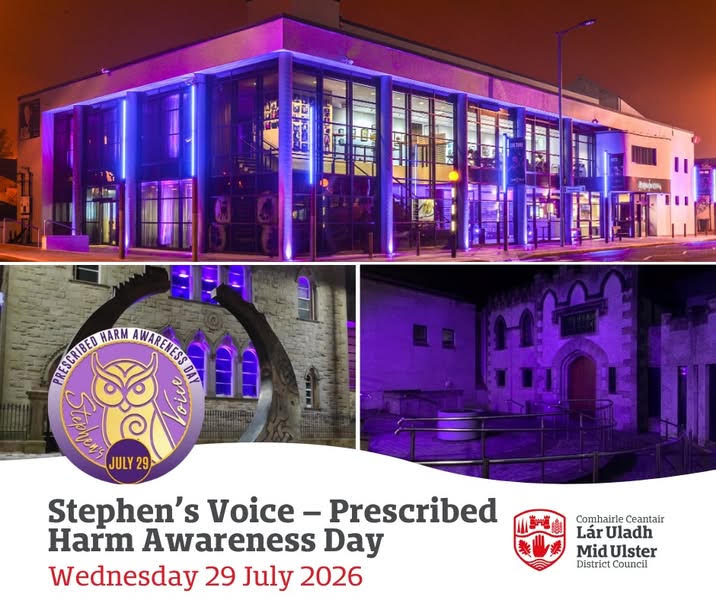
Mid-Ulster Council lit up for July 29
Dr Gerald Dal Pan
druginfo@fda.hhs.gov
This letter was emailed to Dr Dal Pan on July 29, 2026
See Prescribed Harm Awareness and Stolen Lives for more on this.
Dear Dr Dal Pan
I listened with interest to your recent interview with Dr Celia Williams in a Q & A with FDA series, where you were asked which types of adverse event are important to report. I was struck by:
‘We’re particularly interested in serious adverse events that are not listed in the product labelling…other significant situations where the adverse effect should be reported through MedWatch include adverse events resulting in a disability or permanent damage which might impact a person’s physical activities and quality of life’.
In the light of this, it seems almost perverse that, having filed ‘Citizen petition: Sexual side effects of SSRIs and SNRIs’ with FDA in April 2018 (FDA-2018-P-1846), there is still no response. In contrast, EMA and other regulators added the risk of SSRI/SNRI induced enduring sexual dysfunction to patient information leaflets in 2019 or soon after.
Your talk of medication safety for patients raised hopes of recognition along with interview invitations sent to US members of the PSSD community, who had submitted MedWatch reports. Rather than being an encouraging experience, however, those who accepted the invitation were disturbed by an event that was methodologically unprofessional and interpersonally distressing.
1.
The interviewer, a psychiatric pharmacist, Dr Joseph Cusimano, declined to identify himself by name. His explanation was that this was ‘to protect’ himself or the organization. Why so?
This inexplicable behaviour goes against standard professional practice and the broader federal norm covering government interactions with the public. It is also devoid of interpersonal sensitivity – when interviewing a respondent about something as deeply personal as their sexuality – it is obviously important to build trust and a connection. To quote an interviewee:
“I was quickly turned off by the interviewer when he declined to identify himself by name and stated, when I asked, that the purpose was “to protect himself” or perhaps he said “to protect ourselves” suggesting this anonymity to be FDA policy. This interaction set up a reversal dynamic in which Dr C, the interviewer is behaving as the vulnerable party instead of the harmed individual being interviewed.”
2.
It is established research practice to build rapport with comfortable questions, before moving to more sensitive, difficult or complex topics. Dr Cusimano’s first question was: How frequently do you engage in masturbation? In an interview about PSSD, the subject of masturbation is relevant but wholly unacceptable as a first question from a strange, nameless man. It is also unacceptable that FDA did not use a female interviewer for female respondents. To quote an interviewee:
‘Asking intrusive questions is an interpersonal skill, not a matter of simply reading questions aloud. After declining to identify himself, Dr C opened with, “How often do you masturbate?”
3.
Another research basic is that interviews should follow a logical conversational flow. The respondents found the flow illogical – mixing a exploration of PSSD symptoms with questions about possible confounders.
This ordering was not simply awkward. Many felt the purpose of the interview was to invalidate their disability rather than investigate it.
4.
The US is better known for structured qualitative interviewing than Europe. Conducting any face-to-face interview is an opportunity to elicit real insights from respondents. Dr Cusimano reportedly just asked his list of questions and failed to follow up on any subtleties respondents were trying to communicate. To quote several interviewees:
“What bothered me most about the interview was not the content of the questions themselves, but the absence of curiosity about the answers. Had the interviewer simply asked, “Tell me more about that,” or “What motivates masturbation for you now?” or “How does that experience differ from before PSSD?” the data would have been richer.
The questionnaire appeared to treat masturbation frequency as though it were a relatively straightforward proxy for libido or sexual function. For many people with PSSD, I don’t think that assumption holds.
Masturbation may continue for reasons that have little to do with sexual desire… such as an attempt to maintain genital health through blood flow, to see whether anything had changed, or to preserve some connection with a part of myself I hoped might eventually recover.
I was asked a ton of questions including the onset of PSSD such as genital numbness. I was asked to describe what that was like… I figured that this would get us somewhere, but it seemed to make no difference after I took an hour to fill out the interview. As of present (July 2026), I never heard from them again. I feel like I wasted my time.”
5.
Were these questions reviewed by senior personnel? Did Dr Cusimano have any research training or oversight? In what light would a Yes answer paint FDA?
6.
A ‘helicopter’ view suggests FDA’s perspective is dominated by industry funded RCTs and industry specified language and is devoid of insights from those experiencing a medication’s effects.
This questionnaire specifically appears to rest on assumptions that may not hold for people living with PSSD. Rather than eliciting the phenomenology of PSSD, it risks not just allowing its distinctive features to fall through methodological cracks but actively drops them through.
The disconnect between this interviewer and patient experienced PSSD realities features in other FDA investigations of ADEs. For instance, a fluoxetine trial designed to treat premature ejaculation by reducing penile sensitivity and demonstrating it did so has apparently been used by FDA to justify not recognizing PSSD[1]:
‘With clomipramine, there were significant differences observed in sensory thresholds, suggesting clomipramine increases the sensory threshold for genital stimulation. In the fluoxetine study, which was placebo-controlled, penile sensory thresholds were increased as compared to placebo. However, in neither study did patients report “genital anesthesia” or decreased genital sensation.”
‘…reports specific to alteration of genital sensation are rare…DPV suggested this may reflect a more general sexual arousal disorder, not a local neurophysiological effect. In this circumstance DPV concludes penile anesthesia is a misnomer’.
Why are reports of alteration in genital sensation rare? Because investigators in company trials, like me, were told by companies (GSK in my case) not to ask about sex.
The Cusimano interview questions feature in appendix 1 below. I am also attaching a brief clip from a 2023 BBC Panorama program. BBC was the first major broadcaster to feature PSSD. Dr. Audrey Bahrick is central to their program. I have permission from BBC to forward this specifically to FDA.
Dr Bahrick was the author of the first peer reviewed publications on PSSD, and in 2008 working through Senator Grassley, she drew PSSD to FDA’s attention. After watching the video clip, can you even begin to imagine what it would be like for a woman like this, a licensed PhD psychologist, to find herself faced with a nameless man asking rat-a-tat-tat questions like those in the appendix?
In passing let me note, at a time when most people with PSSD were attempting to conceal the fact this problem affected them, the strain of which contributed to suicides, linked to the 2018 petition, over 80 of those affected and over 30 of their physicians offered FDA their names, contact details, causality assessments on their condition and indicated a willingness to be contacted. FDA declined this offer.
Rather than complain, I’d prefer answers. I will circulate any that reasonably exculpate FDA.
I doubt if FDA are aware, and, if not, this lack of awareness seems pertinent, but I am sending you this letter on Prescribed Harm Awareness Day.
Yours sincerely
David Healy MD FRCPsych
Petitioner Docket (FDA-2018-P-1846)
[1] Medical Officer’s Consultation. Adverse Effects of SSRIs and SNRIs on Male Sexual Function. June 2021 – from FDA SSRI/SNRI Labelling Discussions Reviews Reference ID, 4857112, 4840939, 4840941, 4827206, 4808969, 4812060, 4808409, 4803362, 4793552, 4793478, 4787628.
[2] Let me note for the record BBC made a mistake in this clip. Inexplicably, they appear intentionally to have called Dr Bahrick a counsellor.
Appendix 1: FDA/Cusimano Questions
For more on this See Adverse Events need a Human Touch
Sexual history:
- How frequently do you engage in masturbation?
- Do your sexual problems persist during masturbation, or only during partnered intercourse?
Symptoms:
- You mentioned in your report that the symptoms of sexual dysfunction emerged “almost immediately.” What was the pattern in which the symptoms emerged? E.g., did all the symptoms begin at once, or did you notice some symptoms first before others? Did symptoms emerge at the same severity?
- Had you ever experienced any symptoms of sexual dysfunction prior to taking X
- Were there any significant life events occurring during or around the time when you first noticed these symptoms?
- How would you describe your mental health in the period after you stopped taking X?
- Do you have trouble getting in the mood for sexual activity (libido)
- Do you have difficulty achieving an erection/vaginal lubrication for sexual activity?
- Do you have difficulty maintaining an erection/ vaginal lubrication during sexual activity?
- Do you experience discomfort/pain during sexual activity?
- Do you experience headaches during sexual activity?
- Where is the genital numbness located? For example, is it strictly genital – if so which part – or does it involve any other areas on your body?
- Are the area(s) insensitive to pressure? That is, unable to feel anything by touch.
- Are the area(s) insensitive to temperature? That is, unable to feel any change in temperature, like warmth or cold.
- Are the area(s) insensitive to pain? That is, unable to detect painful stimulation, like a pinch or poke.
- Are the area(s) accompanied by any type of pain? For example, electric shock or tingling pains.
- Did you experience any other side effects when you took X?
- How have your symptoms changed over time? E.g., have they worsened, improved, stayed about the same, or waxed and waned
- How have these symptoms impacted your intimate relationship(s)?
Medical history:
- What is your height?
- What physical health problems have you been diagnosed with in the past? For example, high blood pressure, high cholesterol, diabetes, damage to the spine. .
- What mental health problems have you been diagnosed with in the past? For example, depression, bipolar disorder, borderline personality disorder, anxiety.
- Do you currently or have you ever engaged in self-injurious behavior? Do you currently or have you ever had thoughts of suicide?
- What surgical procedures have you experienced in the past?
- What sexual problems have you been diagnosed with by a licensed medical professional in the past?
- What treatment have you received for sexual problems? For example, use of medications, psychotherapy, or other techniques.
- How much alcohol do you consume in a month?
- Have you ever smoked tobacco? If so, how much and for how long
- Have you ever used or currently use any other recreational drugs? For example, marijuana/cannabis, opiates, amphetamines, cocaine.
- Does your doctor attribute your current sexual problems to X?
- What urological or gynecological examinations have you received? (That is, procedures or tests performed by specialist in urinary and reproductive health problems.).
- Do you experience any difficulty walking or standing?
- Do you have a history of any events in your life that you would call traumatic?
- Do you have a history of sexual trauma, occurring during childhood or adulthood?
- What prescription medications do you currently take? Include all forms of medications, including pills, creams/ointments, injections, etc.
- What over the counter medications do you currently take? For example, acetaminophen (Tylenol) as needed for pain.
- What herbal or supplement medications do you currently take? For example, multivitamins.
PHQ‐2 and GAD‐2
Over the last 2 weeks, how often have you been bothered by the following problems?
- Little interest or pleasure in doing things: Not at all, Several Days, More than half the days, or Nearly every day?
- Feeling down, depressed, or hopeless: Not at all, Several Days, More than half the days, or Nearly every day?
- Feeling nervous, anxious or on edge: Not at all, Several Days, More than half the days, or Nearly every day?
- Not being able to stop or control worrying: Not at all, Several Days, More than half the days, or Nearly every day?
Feel free to include any additional information or records that you think would be helpful. Thank you for your time and for submitting your report to the FDA.
Dr. C.
annie says
Dr. C., like a Bull in China Shop. As is pointed out, being anonymous was a terrible start and pushing on with clearly no understanding or even interest in PSSD.
Dr. C., deserves all the criticism coming his way. It is safe to say, his approach could push a sensitive individual over the edge let alone the dire way all the way the questions are framed.
This was a terrible approach, quite horrifying.
The link below, two links are not available. Link three has a part about PSSD, features David Healy, also features a stand-up comedian who uses PSSD as part of his stand-up act. Also features a lad with excruciating PSSD.
https://www.pssd-uk.org/news1/bbc-panorama-episode-the-antidepressants-story-covers-pssd
What is so awful about the FDA approach, is that it is not an uncommon approach. A psychiatrist came to my home unnecessarily, when I was outside my house on the beach with my dog. Within minutes he had me in tears by blurting out “are you suicidal?” I was so shocked, I should have asked him to leave. Where was this going, what was he doing? I was trapped with a stranger shocking me, in my home, probing and probing, just like ‘the programme’ of questions Dr. C came up with.
This is a Cracking letter…
tim says
Thank you RxISK for identifying the 29th July as PRESCRIBED HARM AWARENESS DAY. This is such an important PUBLIC HEALTH and Educational Opportunity for Prescribers and Patients..
Many years ago, all of our patients with AIDS endured an increasing cascade of opportunistic infections and AIDS induced malignancies, such as Kaposi’s Sarcoma. Initially we had no anti-retroviral drugs. AZT was the first, toxic and short lived treatment for the virus.
It was TRIPLE THERAPY that remarkably lead to almost normal life expectancy. When the viral load was undetectable, infectivity was dramatically reduced and HIV infected pregnant women could have neonatal infection prevented.
The Concept of WORLD AIDS DAY was unique to this period and greatly increased public awareness and disease prevention.. It enhance our collaborative advocacy for resources to care for this often rejected (and then) often vilified group of patients.
It must be our hope that increasing awareness and media coverage of PRESCRIBED HARM AWARENESS DAY achieves a similar level of national and international recognition and thus: – HARM PREVENTION.
How many thousands of families of the prescribed drug deceased, maimed and wrongly diagnosed spent the 29th July enduring their unrelenting grief and regret that a trusted prescription should never have been issued or taken?
mary H. says
Tim, I’m sure you’ll agree that the success of yesterday was quite astonishing. Let’s hope that you, me and the rest of the “fighting fit” ( fighting OLD and fit in our case maybe!) can now carry on supporting the work that has already gathered pace.
I’m sure we wish Katinka, Colleen and all of the other ‘miracle workers’ a weekend of rest as we congratulate their success. It would be really good if they share any new ideas with us, maybe on here, to inspire us to walk in their footsteps wherever possible.
Thank you to all who played a part in that success and for the chance to see and read of Risk’s part on this special day too.
Now we shall hope to hear of some interesting news on the genomics front which should provide hope to the many who feel totally cast out of the medical story at the moment.
tim says
Thanks Mary,
Re PRESCRIBED HARM AWARENESS DAY.
Very pleased to join you in thanking Katinka, Colleen and all of the ‘miracle workers” for their absolute commitment, total dedication and inspiring achievements.
annie says
Hard-hitting ‘down under’ – plus
https://www.einpresswire.com/article/929972873/missd-expands-global-akathisia-awareness-campaign-to-australia
Katinka Blackford Newman reveals all in the video. Listen to Katinka give an awe-inspiring narrative that will leave listeners shuddering in fright and how it led her to where she is today. The most incredible, frank, erudite, journey, of her life.
annie says
Vincent, Yoko and Romain
https://x.com/leprogreslyon/status/2083070741973471337/photo/1
Guest on Bonjour Lyon: Vincent Schmitt raises awareness about the risks of antidepressants
https://www.youtube.com/watch?v=UD2UXG2Qb6w
Antidep Effects reposted
Stephen’s Voice – Suicide Prevention
@VoiceStephen
The Landmark Antidepressant Case That Still Matters Today
https://x.com/VoiceStephen/status/2081479544536526916
More than 25 years ago, one court case changed the conversation around antidepressant safety forever.
Merci
Harriet Vogt says
Dr C is clearly an interpersonal car crash of an interviewer who should never have been unleashed by the FDA . As a psychiatric pharmacist – interviewing quite likely isn’t his day job. Nor should it be.
But it is the day job of GPs and psychiatrists – and the experience Annie described is telling. It seems quite extraordinary that psychiatrists, supposedly a caring, insightful profession, seem to have so little idea of how to communicate with humans in extreme states of distress, at risk of taking their own lives.
The UK system finally grasped why it was evaluating those who went on to kill themselves as low risk for suicide. As has been known for years, the subtext of the questions that were being asked of these patients was effectively – ‘tell me you’re not going to kill yourself. I’m your doctor and the last thing I want is for you to take your own life (and for me to be held responsible):
https://link.springer.com/article/10.1186/s12888-017-1212-7
The ‘assessment tools’ that were being used to ’measure the extent’ of a person’s suicidal intent were obviously ridiculous and wholly insensitive – expecting a human being driven by their emotions to answer weird evaluative questions like those in the COLUMBIA-SUICIDE SEVERITY RATING SCALE
(C-SSRS), e.g.
1. Wish to be Dead
Subject endorses thoughts about a wish to be dead or not alive anymore, or wish to fall asleep and not wake up.
Have you thought about being dead or what it would be like to be dead?
Have you wished you were dead or wished you could go to sleep and never wake up?
Do you wish you weren’t alive anymore?
If yes, describe
As we know, in 2025 the UK system ditched all this and segued into a ‘bipsychosocial’ approach to suicide prevention 1) safety assessment (explore) , 2 )safety formulation (map): 3)safety management and planning act and plan etc.etc.
https://www.england.nhs.uk/long-read/staying-safe-from-suicide/
It’s not fundamentally wrong – just process-driven and formulaic – I guess to protect the system as much as the patient. But what is fundamentally wrong is that the list of ‘precipitating factors’ yet again excludes .arguably, the most obvious and clearly identifiable one – prescription drugs.
Looking at the group with the highest suicide rate, middle aged men (though the group showing the greatest increase in suicide Is young women) 43% of them saw their GP in the 3 months before taking their own lives and in over half of these cases the medication they were on was an SSRI/SNRI.
https://pmc.ncbi.nlm.nih.gov/articles/PMC10170520//
The final act of suicide often seema to be largely impulsive – although built on complex individual foundations. We know that medication changes can trigger toxic states leading to suicide – even homicide. Wouldn’t it make sense for a system struggling to prevent suicide, to pay attentkon to that relatively tangible factor? And wouldn’t it make particular sense at a time when the MHRA is supposed to be delivering – FINALLY (one day, maybe) – its updated SSRI safety comms? Strategic incoherence worthy of more letter writing perhaps…