
This post is from Johanna Ryan. A post on DH – Artificial I – semi links in.
Social media platforms like TikTok and Instagram, we are often told, are a portal into the Zeitgeist of today’s young adults. If you want to understand Generation Z (ages 15-30), or their Millennial elder siblings, just dip into these platforms and listen to the youth express their real feelings in chatty, spontaneous videos. You’ll soon learn that they regard psychiatric diagnoses as essential aspects of their identity. And far from recoiling against antidepressants and other psych meds, they embrace the drugs eagerly and refuse to be “shamed” out of reliance on them.
Right? Well … maybe yes, maybe no. Maybe the content we’re being served is not as authentic or unscripted as it looks.
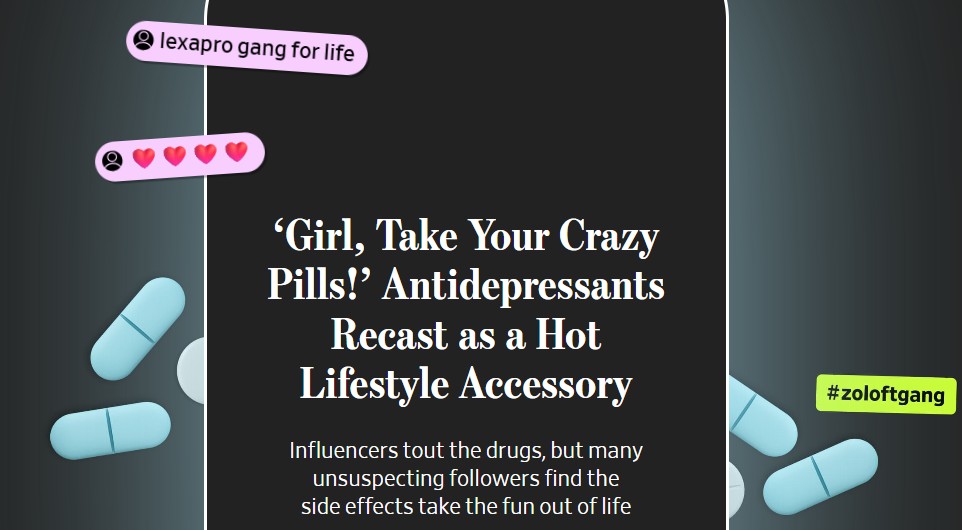
A recent article in the Wall Street Journal found that many of those personal stories were in fact paid posts. Even more troubling, the Journal noted:
“the rosy picture painted by cheerleading TikTok and Instagram influencers glossed over potential adverse effects. Some suffered side effects that diminished rather than enriched their lives, but kept quiet about it on social media.”
In other words, their real-life experiences did not match the success stories they had fed their followers. Full WSJ article Here.
A word from our sponsor
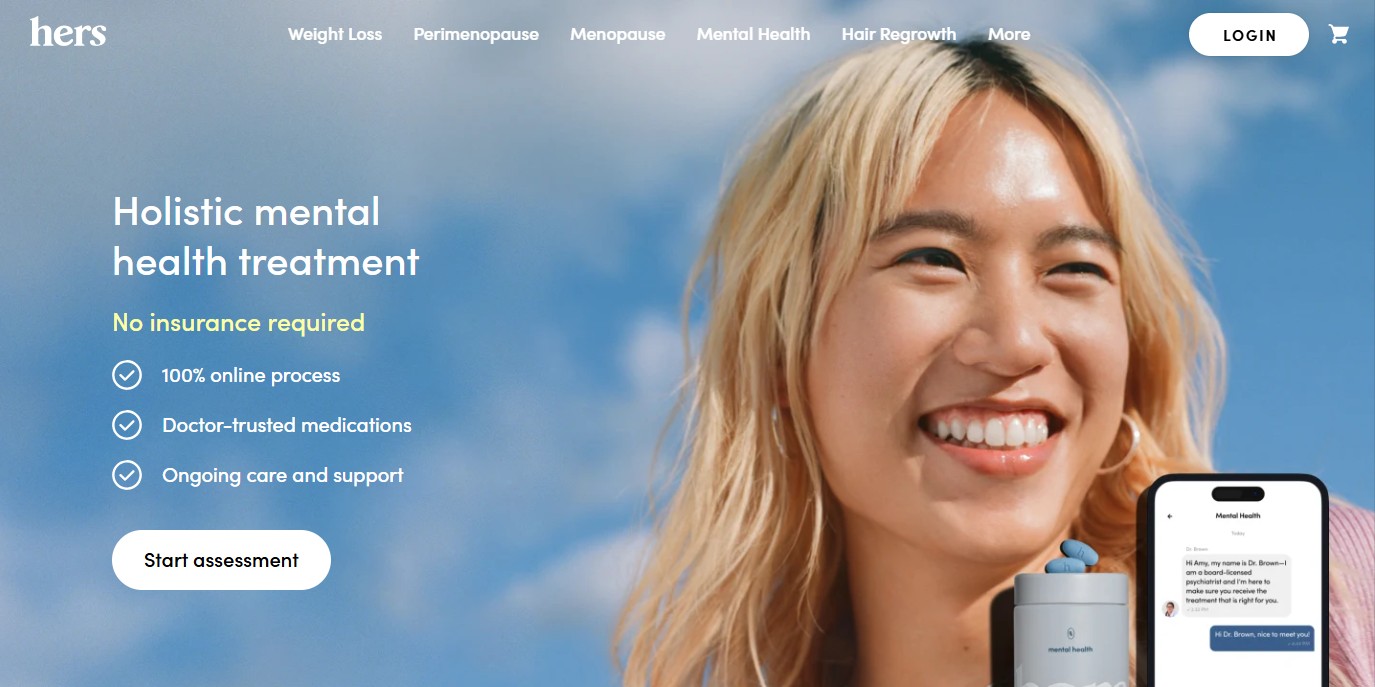
In this case the customer was not the drug company, but a commercial telehealth platform which stood to profit by writing a prescription for the drug being praised. Hims and Hers Health specializes in “lifestyle drugs” sought after by younger patients: erectile aids for men, birth control for women, and antidepressants for both sexes.
Hims & Hers has plowed more than $521 million into digital marketing since 2021, with Hers – the business unit aimed at women – spending a significant chunk on Instagram, TikTok and Facebook …
The company ran an influencer campaign in 2022 and 2023 that targeted young women with a simple message: Don’t be ashamed to take medications for depression and anxiety. Hims & Hers paid between $3K and $10K to influencers for making Instagram and TikTok posts, a person familiar with the deals said.
Here are some of the influencers profiled by the Wall Street Journal:
Corinne Byerly
Byerly, a stay at home mom, recalled days when she felt lonely, overwhelmed and at times paralyzed with anxiety and self-doubt. Byerly, who had neither health insurance nor money for psychotherapy, was intrigued at hearing a former MTV star talk up Lexapro on a podcast in 2023.
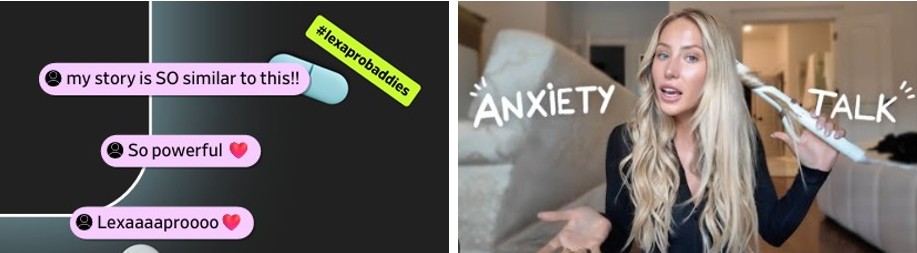
She searched for the drug on TikTok and was connected to Hers.com, where she filled out a questionnaire. An online nurse practitioner prescribed Lexapro, telling her that “any side effects are generally mild and usually subside quickly.” Byerly posted videos to her 11,000 Tik Tok followers showing her running to the mailbox to get her pills, using hashtags like #lexaprobaddies and #gethelpmama.
But while the drug helped at first, the side effects “blew the whole thing up.” She struggled with emotional numbness, brain fog, weight gain and sexual dysfunction. She finally went off the drug completely and suffered withdrawal symptoms. But for months she held off telling her followers about her problems.
Nadya Okamoto
Okamoto was one of the influencers paid by the company, including for an Instagram video she posted in December 2022. At the time, Okamoto had, in fact, been trying to reduce her Zoloft dosage …
The medication had numbed her sex drive and caused her to sweat profusely in her sleep, Okamoto said. On a podcast a few months after her paid posts for Hers, she skewered the medical profession for pushing antidepressants.
Like Corinne Byerly, Okamoto initially found her antidepressants to be “life-changing,” but later found herself feeling numb and emotionless. She now hopes to taper off Zoloft entirely; she plans to start a family soon and doesn’t want to be on the drug while pregnant.
Elaine Davies, an influencer who also has a popular podcast on Apple, also praised Lexapro in a 2023 TikTok video paid for by Hers. She has since tapered off.
Ariella Sharf
In 2019, Ariella Sharf revealed to her Instagram followers that she had been taking ADs to cope with anxiety and depression. Without Zoloft, “I struggle silently,” posted Sharf, who has been taking ADs since college.
The 32-year-old now has a different message for her 6,500 followers. The pills she credits with saving her life also “nearly broke me,” Sharf said. Zoloft made her emotionally numb, took away her appetite and left her sweaty and sleepy …
Sharf decided last year to taper off Zoloft … she described on Instagram her body shakes, dizziness, “nausea creeping up my throat” and “eyes and lips drier than the Sahara desert.” “Emotionally, mentally and physically excruciating in ways that make no sense,” she wrote at the end of July.
Authenticity, Inc.: an alpha influencer
At least one apparently satisfied influencer was Alix Earle. However, the Journal was unable to speak to Ms. Earle; her agent told them she was unavailable to comment.
Earle, who has 7.7 million followers on TikTok, disclosed in a December 2022 video that she has been on Lexapro for anxiety since high school. In the video, which got 6.6 million views, she shook a prescription bottle of pills and urged watchers to talk to a therapist if they have similar symptoms. She has since posted more videos about Lexapro and anxiety
At 27, Earle is a giant of the influencer world whose net worth reached $6 million by 2023. For a time her podcast, Hot Mess with Alix Earle, outranked even Joe Rogan’s.
She’s regarded by millions of young women as their “hot best friend” or big sister as marketers explain. The perceived honesty and relatability of her personal day-in-the-life videos builds “a sort of trusting, friendly familiarity with her audience” so that her endorsements seem more like advice from a friend than advertisements.
One follower was excited to hear that the fabulous Ms. Earle was a fellow “Lexapro girly”; it proved that even “the baddest bitches have crippling anxiety.” Another woman told the Journal she had tried antidepressants twice and experienced no relief – only emotional numbness and sexual dysfunction. After watching Earle sing their praises, however, she decided to try a third time (with the same grim results).
A girl just like you—or a paid spokesperson?
Celebrity drug endorsements are nothing new, at least in the United States. From time to time drug companies have been criticized for this type of marketing, as in 2015 when Kim Kardashian’s Instagram posts for a morning-sickness drug failed to include standard FDA-required warnings. Celebrity content, however, is pretty easy to spot as paid promotion (as in this Shingles Vaccine Ad featuring 1980’s football legend Terry Bradshaw).
But influencers are different: “Authenticity” is their most important asset. The viewer must feel that Alix Earle “struggles just like me” (and maybe my life can be as amazing as hers if I use the same products.) However, digital influencing has morphed from a bottom-up, rank-and-file activity to a multi-billion dollar business which is viewed by many young adults as a promising career path.
The influencers profiled in the Journal illustrate the spectrum: Alix Earle makes millions putting her seal of approval on everything from drugs to cosmetics and cocktails. Corinne Byerly, by contrast, appears to be a genuine amateur. Nadya Okamoto, Elaine Davies and Ariella Sharf are somewhere in the middle: all are professionals with their own podcasts on large platforms like Apple, Spotify and YouTube.
Their paid posts for Hers, the Journal noted, were “typically” identified by hashtags such as #sponsored or #herspartner. However, while the FDA is at least supposed to monitor pharma ads in TV or magazines, here no one is keeping track. When is your TikTok “best friend” speaking her (or his) mind, and when are they working for pay? You can’t know for sure.
The future of telehealth:
Centering products, not providers?
Telehealth moved from the periphery to the center of medicine five years ago, with the help of the Covid-19 shutdowns. Antidepressant use also spiked in this period, “especially among young women in their 20s and early 30s,” according to the Journal. “Social media chatter about the medications went viral about the same time.”
GLP-1 weight-loss medications are now the real growth market, due to a combination of high demand and insurance-company reluctance to pay without a diabetes diagnosis. Pharma is eager to get in on the action. Rather than simply working with outside platforms like Hims & Hers, companies like Lilly, Pfizer and Novo Nordisk have launched their own direct-sales platforms.
President Trump has proposed a new platform, “TrumpRx,” that would offer price cuts to patients willing and able to pay cash. A number of drug companies seem interested.
In the process, the telehealth business has increasingly moved towards “drug-first” thinking, according to Boston-based STAT Health News. What began as a way to help patients access doctors is now a way to help companies sell drugs. “Instead of starting with a set of symptoms and a clinician deciding which, if any medication might be appropriate treatment, an interaction might start with a patient putting a drug into a digital shopping cart before ‘checking out’ with a provider’s signoff,” notes STAT’s Katie Palmer.
The online nurse practitioner who administered a questionnaire to Corinne Byerly and “signed off” on her script for Lexapro may soon be a fairly typical provider, with a shrinking role and diminished authority. Who will fill the resulting power vacuum – patients, or profit-driven drug and healthcare companies?
There are 2 Stat articles on this topic here
A Reuters article
And an older article by Freya India, who has a RxISK fan club
And there are semi-linked articles on DH – Artificial I – with another coming next week and one the week after.
Dr. David Healy says
There’s a 2006 film called Idiocracy. It’s a comedy about a man who is cryogenically frozen as part of a science experiment and wakes up several hundred years in the future.
He discovers that humanity has devolved into a state of extreme stupidity. Society has collapsed because nobody can do even basic tasks or understand simple concepts.
It’s not a very good film, but it’s amazing how accurate it has become.
There’s even a plot about big corporations who have replaced all water with their soft drink, which is inadvertently preventing people from growing crops. When the guy discovers this and takes steps to rectify the water grid, the corporations start firing people and so everyone gets angry at the guy for causing trouble.
Such a parallel with people getting angry when told their drugs can be harmful.
annie says
Secretary Kennedy@SecKennedy 9h
Drawing on the nation’s most comprehensive data, the @CDCgov is finally confronting the long-taboo question of whether SSRIs and other psychoactive drugs contribute to mass violence.
https://x.com/SecKennedy/status/1985820976852988221
FDA Hearing
Peter Selley says
Thank you Johanna
Sanofi has put together a squad of paid celebrity ambassadors for Beyfortus, including actor-singer Mandy Moore, author Elaine Welteroth, chef Gaby Dalkin, citizen astronaut Katya Echazarreta and gold-medal Olympic gymnast Shawn Johnson East.
https://youtu.be/zw48YjBFzog
They would know.
“Join the more than 6 million moms who’ve had their babies Beyrified—verified they got Beyfortus”
annie says
These smart young folk are amassing more money than most young folk can dream of as influencers. Influencers are everywhere and their audiences are huge in the Gen Z market.
It seems to have been a hidden industry until the WSJ exposed it. Who needs Pharma ads when the influencers are influencing.
Of course, the more elderly and experienced will look stricken by the level of naivety.
Influencers peddle everything and anything that gets them thousands of clicks. Here you have a leader and follower syndrome. Somewhat like the Pharma ads, they talk, the sheep follow. Robert Kennedy is planning to make Pharma promote adverse effects clearly.
This is a new generation finding their feet, making money, being primed by soulless enterprises. It won’t be on their radar, the fifty odd years of science debunking, that they are ’emotionally labile’, that they might turn in to an alcoholic, end up with no sexuality, go on one of the worst trips of their life.
Perhaps these antidepressant influencers should be left to learn by experience, how else do you learn if not by experiences. They are too young to have learnt that they could be being exploited, what harm in a pill. Hey girls, let’s take it, ClickClickClick
After all, this is what we did. Hey, Hims and Hers..
Dr. David Healy says
Annie
It hasn’t been hidden. Its been out there for a while.
One of the big issues is that I often mention for instance with Woody Witczak would be alive today if he took the very strong SSRI – chlorpheniramine – because it is OTC and no doctor would have stood in the way of him stopping it when it didn’t suit him
When I first raised the OTC option nearly 30 years ago it was to invite people to recognize that one of the hazards of prescription only is that it meant a doctor had to give you an illness, make you ill, in order to give you a drug. I said at the time and since that while there might be benefits this arrangement would generate its own perversities, its own hazards.
The other thing what was very clear with drugs that are both lifestyle and routinely give reliable results – like Viagra or Propecia – there would be a push to making these available OTC
We are seeing marketing imperatives impacting on this scene now. Some people will get killed as a result. Some European countries are aiming at getting Propecia banned completely – which also seems a mistake – it very reliably gets hair regrowing.
We need to find a sensible way to live with drugs. The problem is that most of us are like Oscar Wilde – we can resist everything except temptation – even an old dude like me can feel the temptation to try Propecia.
Will we? Can we? Or are they too like forbidden fruit on a tree.
D
annie says
I meant ‘hidden’ from the general population, not from us, who read Harriet, who often posts revelations of her revealing interactions.
If a drug called an antidepressant was OTC, I certainly would not have bought it. I didn’t want it in the first place. I really don’t think many would have bought it, as most ‘suicides’ that occurred did not show a feature leaning towards depression and/or anxiety.
Would GSK have made more if it was OTC? The profits from OTC are astronomical, look at the hundreds of packets and bottles of stuff in Chemist shops. I am always stunned at shelves and shelves of unctions and potions, like latter day ‘snake oil’ salesmen.
If antidepressants were OTC, GSK might have had a problem with the Consumer Act. Could they really claim that this drug lifts depression/anxiety. Certainly GSK would not have had to pay $3 billion in fraud charges.
Greying hair, like baldness, can be a very nice image. Why hide it away, as if ageing is something to hide. My own greying, and thinning, always makes me wish I looked like Joan Baez. An old friend in Canada recently said to me that the woman I was talking to looked like Joan Baez. She looked nothing like Joan Baez, but I could see that this 81 years old, would have liked her to be Joan Baez.
Image has a lot to do with Image, as no doctor ever said..
Harriet Vogt says
We all saw industry testing the OTC antidepressant waters in a rash of PR pieces fronted by KOLs like Roy Perlis published in early 2024.
‘What’s needed to make this happen? An SSRI manufacturer with the courage to engage with the FDA and invest the necessary resources for a prescription-to-OTC switch, a well-trod path that has previously included medicines for allergies, acid reflux, and emergency contraception, among others. This process would primarily involve studies to prove that consumers can understand and follow the medication label, not new clinical trials, because more than three decades of evidence shows that SSRI antidepressants are safe and effective’.
https://www.statnews.com/2024/04/08/time-is-right-for-over-the-counter-antidepressants/
This was greeted with kneejerk howls of outrage by patient safety campaigners- and certainly the ‘safe and effective’ claim is worthy of absolute derision. But they weren’t thinking it through- as you had done as early as 1997 in The Antidepressant Era, maybe before then. What you wrote in the Postscript really resonated with me:
‘Could chlorpromazine have remained available over the counter? …The hazards of chlorpromazine therapy in recent years have been owing to its prescription by medical personnel rather to the intrinsic properties of the drug. In the pursuit of the chimera of specificity, the failure of an individual to respond to treatment has often meant that doses of these agents were escalated during the course of the 1960sand 1970s to heroic levels-levels no patients would have contemplated giving themselves’.
The bottom line- and in the end money is always a/the key driver – is that national health services, primary care especially, cannot support the escalating manufactured demand for treating ‘anxiety’ and ‘depression’, nor governments the disability costs. Industry has switched its attention to richer pickings. This is the turning point for OTC.
I thought the idea you mooted nearly 30myears ago of repositioning certain antidepressants as OTC tonics -that enhance appetite, sleep, drive, libido that ‘don’t convey the same sense of constitutional or moral failing’ – was a great piece of safe lifestyle marketing.
As you often say, no consumer would flog on with a tonic/dose that made them feel suicidal or dizzy or numb. It’s significant that even the last estimate I saw, based on a real world study, just on 40% of patients had bailed out at 8 weeks, even when prescribed – and many likely imagining there was something wrong with their brain chemistry.
https://www.cambridge.org/core/journals/the-british-journal-of-psychiatry/article/realworld-effects-of-antidepressants-for-depressive-disorder-in-primary-care-populationbased-cohort-study/2364972207BAD22AE4A5B30A8BFBB224
Harriet Vogt says
Johanna’s analysis is disturbing. Not only because those of us – on the inside – will be familiar with its truth. But because it’s quite likely that, just for starters, Alix Earle’s – numbers vary – but as many as 9m TikTok followers – won’t.
I tried watching her ‘Hot Mess; Podcast (great brand name) – ‘Anxiety` – from Hospital to healing’. I managed 11 out of the 51 minutes. It felt so painfully inauthentic and scripted, Yes, I’m sure she did experience panic attacks aged 14. Don’t most adolescents? But – ‘I was this shell of a human that was scared to wake up every day’ – really? What finished me off were the faux protestations- ‘I thought I could sort it myself, I’m weird about medicine, I didn’t like talking about anxiety.’ But, in the end our heroine overcame the stigma, she’s not ashamed.
https://www.youtube.com/watch?v=oCIVRPZ7kZ0&t=288
As Johanna observes, and we know this for a fact, young women especially adopt, ‘mental health’ diagnoses and drug regimens , as part of their identities, Lexahoes, the baddest bitches and all that. And we’ve seen the endless permutations of sexual identities available off the peg, as well as plastic breasts , lips filled to bursting, uniformly micro -bladed eyebrows etc.
I think what’s really going on- and I’m sure this is far from an unique insight – is that any human whose primary projection of self is through social media is by definition- inauthentic. It’s PERFORMATIVE AUTHENTICITY – the opposite of real.
And what this means is that there’s a vacuum between the person and their inauthentic projection – that is waiting to be filled with what have become the consumer goods of diagnoses and medication – and likely psychotherapy – as well as all the other trappings of a performative existence. It’s perversely appropriate that they are available mail order – with minimal medical oversight.
This may be wishful thinking – but I do sense there are growing numbers of posts on X where people are ruing the day they swallowed SSRIs and lost their authentic sense of feeling. This was one today, Jack Harris’s song, ‘Careful what you wish for’:
‘I miss my old emotions
I miss the pain I used to have
I’m going through the motions
I’d sell my soul to make me sad.’
Equally there was a post – surely a bot ?-@mysoftdose promoting branded drug adornments – 200mg Quetiapine ear studs and a Viagra tongue stud. This seemed like a bridge too far. But in a performative universe, anything goes.
https://x.com/MySoftDose/status/1985286730053034293
annie says
Hims & Hers cofounder and Chief Executive Andrew Dudum
“We refuse to be strong-armed by any pharmaceutical company’s anticompetitive demands that infringe on the independent decision making of providers and limit patient choice,” he said.
Wall Street Journal
https://archive.ph/VNLGW
andrewdudum@AndrewDudum
Around 100 FDA letters went out last week to companies across the industry as part of the administration’s recent push on pharmaceutical marketing. We got one. A number of big pharma companies received them. With this industry-wide push, the FDA is demonstrating its commitment to ensuring individuals can make informed choices about their care – a commitment we share and something Hims & Hers was built to do. We have a long history of working with regulators to keep customers safe, and I’m looking forward to continuing that work with the FDA. Want to learn more? All the letters are here:
https://x.com/AndrewDudum/status/1968002019563905092
WARNING LETTER
Hims & Hers Health, Inc. dba Hers
https://www.fda.gov/inspections-compliance-enforcement-and-criminal-investigations/warning-letters/hims-hers-health-inc-dba-hers-09092025
Dudum – seems to have an optics oversight; pity about his name
Dr. David Healy says
The post focusses on Influencers but what about lifestyle coaches.
From: Jonathan White
Date: Wed, 5 Nov 2025 at 18:33
Good Afternoon,
I hope you’ve had a great week so far! My name is Jonathan White, and I am the publicist for ADHD Coach Hannah Bookbinder, LSW, M.Ed. Hannah is introducing innovative new tools to vastly improve the quality of life for the millions of people who have ADHD.
Would you like to schedule an interview with Hannah? She’d love to share valuable insights from her work as an ADHD/executive functioning coach, author of Unlock Your Inner Superhero, and creator of My TOAD App™, a tool designed to help people with ADHD manage time, organization, accountability, and distractibility.
Here are a few topics she could discuss:
1. From Chaos to Clarity: Practical strategies teens and parents can use right away to support ADHD brains.
2. Gamifying Executive Functioning: How making EF skills fun can improve focus and consistency across the lifespan.
3. ADHD Doesn’t Mean Broken: Shifting from stigma to empowerment, helping people build self-confidence and resilience.
For almost 30 years, Hannah has developed strategies to enhance the lives of individuals struggling with ADHD and executive functioning skills. Now, she is launching a cutting-edge app for people with Attention Deficit Hyperactivity Disorder (ADHD) and executive functioning skills difficulties, and she is debuting a new book for high school and college students with ADHD:
• The MyTOAD™ App (available on iOS, for people across the lifespan struggling with ADHD and executive functioning skills).
• Her new book Unlock Your Inner Superhero: Conquering the Challenges of ADHD (MyTOAD™; ISBN: 979-8998523113 [Print]; ISBN 979-8-9985231-1-3 [Kindle]; ISBN 979-8-9985231-2-0 [Audio Book]; $18.99 Paperback; $18.99 Audio Book; $9.99 Kindle), specifically for high school and college students with ADHD
Please let me know what would work best for you schedulewise.
Many Thanks, Jonathan
Jonathan White | e. jonathanwhitepr@gmail.com t. 530-219-9797
Dr. David Healy says
Another colleague coincidently sent an email around making the following point:
Physical punishments versus chemical punishment A desperate cry in the face of the increase in “labels” (diagnoses) and treatments (psychotropic drugs).
Physical punishment is always despicable, including in school. Physical punishment in schools has now been eradicated, but pharmacological sentences are imposed, diagnosing and medicating those who deviate from “obedient normality” (ADHD, autism, depression, defiance, etc.).
There are, of course, children who suffer from ADHD, autism, etc., but not every variation from “obedient normality” implies suffering, much less requires diagnosis and medication.
Let children live and enjoy their diversity! Against physical and chemical punishments!
Harriet Vogt says
You’ve prompted me to have a dig around in ‘life coaching’ – since I’ve never met one – just trainers (gym, presentation methods) and consultants (design) – with actual skills and knowledge.
There must be some life coaches who help ‘clients unlock their potential through deep questioning’, as defined by Sharon Lawton, head of training and development at The Coaching Academy – that’s the deal apparently. But there is clearly a lot of dodgy hustle in an exploding, unregulated industry. Stories of clients at some sort of crisis point in their lives being sucked in and sucked dry:
‘Angela Lauria, 50, discovered life coaching when she was struggling with postnatal depression and had been recently fired from her job. In the first year alone, I spent $14,000 working with my life coach, and in the years that followed I probably spent $100,000,” she says. She also spent thousands of dollars on additional courses and mentorships with other life coaches that her primary coach recommended. https://www.bbc.co.uk/worklife/article/20240206-life-coaching-industry-scams
Andrea “My clients call me human Xanax without the side effects” Crowder, who specialises in coaching ‘high-earning, high-achieving female entrepreneurs. And promises transformation in “mind, body, spirit and bank account”, without a trace of irony.
https://www.independent.co.uk/life-style/life-coaching-;’uk-b2647236.html ,
There are some people who have been so badly burned by the life coaching industry, they’re determined to expose it. Danielle Ryan is one such on her Business Coaching Scam Channel. https://www.youtube.com/watch?v=N7fjYgvsxrc&list=PLxwgv-UHeOWtkKiBH45hluL8ume-sxjkc
This is a written snippet from one of the scammed she featured on her channel:
‘ 7 sessions were supposed to be deep and touching my traumas in a meditative state. Working with my sub-coconscious mind and making me release issues I was never aware of. The next 6 sessions were supposed to calm down the open wounds, calm emotions and help me heal for good…I thought she was great, she could identify my traumas so easily and get to the route (sic, spelling a bit telling).
Words fail me.
It feels like the same sort of vacuous dynamic that powers influencers – a target audience so detached from any authentic sense of self – they are open to seduction by any old confected belief system – be it Lexahoism, ADHD-ism, getting to the ‘route’ of my trauma-ism etc,
At least the Maslowian styled self-actualisation, so hilariously captured in one of my favourite Tom Wolfe Essays from the 70’s– ‘The ‘Me’ Decade -The new alchemical dream is: changing one’s personality—remaking, remodeling, elevating, and polishing one’s very self’- was founded in self-awareness, to the point of self-obsession – and far more amusing:
‘Many others are stretched out on the carpet all around her; some 249 other souls, in fact. They’re all strewn across the floor of the banquet hall with their eyes closed, just as she is. But Christ, the others are concentrating on things that sound serious and deep when you talk about them. And how they had talked about them! They had all marched right up to the microphone and “shared,” as the trainer called it. What did they want to eliminate from their lives? Why, they took their fingers right off the old repress button and told the whole room. My husband! my wife! my homosexuality! my inability to communicate, my self-hatred, self-destructiveness, craven fears, puling weaknesses, primordial horrors, premature ejaculation, impotence, frigidity, rigidity, subservience, laziness, alcoholism, major vices, minor vices, grim habits, twisted psyches, tortured souls—and then it had been her turn, and she had said, “Hemorrhoids.’
https://nymag.com/article/tom-wolfe-me-decade-third-great-awakening.html
annie says
Patrick D Hahn@PatrickDHahn
Never before in history have so many people bragged about their inability to cope with life’s mundane tasks, as if this were a badge of honor.
What has happened to us?
https://x.com/PatrickDHahn/status/1982777366637138320
My name is Jonathan White, and I am the publicist for ADHD Coach Hannah Bookbinder, LSW, M.Ed. Hannah is introducing innovative new tools to vastly improve the quality of life for the millions of people
who have ADHD.’a cutting-edge’ app, not the words I’d choose, or many of his words.
‘The MyTOAD™ App (available on iOS, for people across the lifespan struggling with ADHD and executive functioning skills).’
Does he even know what a Toady, is?
We can thank old-time toadeaters for toady. In 17th-century Europe, a toadeater was a showman’s assistant whose job was to make the boss look good.
Hannah Bookbinder, binding her book, Unlock Your Inner Superhero